
I've been installing landscape lighting across the Phoenix area for years now, and honestly, what homeowners are asking for has changed a lot. Some of it's good. Some of it sounds great in theory but doesn't hold up when you're dealing with 115-degree summers and monsoon dust storms. Let me walk you through what I'm actually seeing work in Gilbert, Scottsdale, and the rest of the Valley.
Warm White is Taking Over (Finally)
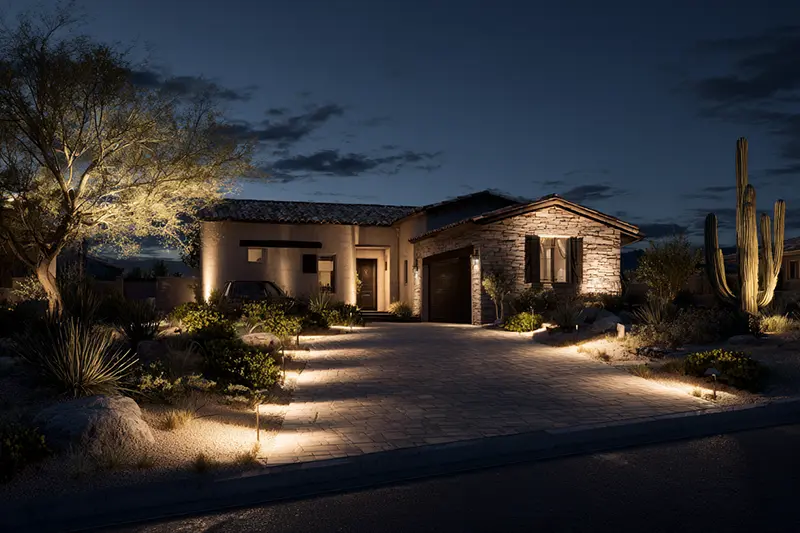
For the longest time, people wanted the brightest, whitest LED lights they could get. They'd see these super blue-tinted 6000K fixtures at the big box stores and think that's what professional lighting looks like. It's not. What I'm installing now is almost entirely in the 2700K to 3000K range, which gives you that warm, amber glow that actually looks natural against desert landscaping.
Here's the thing about our desert plants. Palo verdes have that gorgeous green bark, saguaros get that beautiful texture when the light hits them right, and ocotillos look incredible when they're blooming. Cold blue-white light makes all of that look washed out and weird. Warm lighting brings out the natural colors and creates shadows that add depth. Plus, it's way more comfortable when you're actually sitting outside trying to enjoy your backyard instead of feeling like you're under stadium lights.
Path Lighting That Actually Makes Sense
I'm doing way less traditional path lighting these days. You know those mushroom-shaped fixtures every 6 feet along a walkway? They work, but they're kind of boring and they put light exactly where you don't always need it. What's trending now is more creative wayfinding lighting.
Hardscape lighting is huge right now. Instead of fixtures sticking up out of the ground, I'm recessing lights into retaining walls, steps, and even the sides of planters. It gives you the guidance you need without cluttering up the visual space. In Queen Creek and Gilbert where everyone's got these big pavers and natural stone pathways, the recessed lighting looks clean and modern.
Some clients are going with no traditional path lights at all. Instead, we're lighting the spaces between pavers from below or using very low profile deck lights tucked into steps. It's subtle, it doesn't interfere with the daytime look of the landscape, and it still gets the job done after dark.
Zoned Lighting for Actually Using Your Yard
This is probably the biggest shift I've seen. People used to want everything on one switch or maybe two zones if we were getting fancy. Now every project I do has multiple zones, and clients are using them differently depending on what they're doing outside.
A typical setup might be: perimeter security lighting, entertaining area lighting, accent lighting for plants and architecture, and pathway safety lighting. Each zone runs independently so you're not stuck with an all-or-nothing situation. When you're just running out to let the dog out at 10pm, you don't need the whole backyard lit up like a resort. But when you're having people over, you want the full effect.
The smart home integration is part of this too, but I'll be honest with you, about half my clients set up the app and then never use it. They prefer a straightforward control panel by the back door where they can hit the zones they want without pulling out their phone. The other half loves having scheduling and remote control, especially when they're traveling and want the lights to come on automatically.
Less is Actually More
I get calls all the time from people who want to "light up everything." I always talk them down from that. Too much lighting in a desert landscape just creates glare, washes out the natural drama of shadows, and honestly looks pretty tacky. What's trending now is more strategic, focused lighting.
Instead of lighting every single saguaro in your front yard, maybe we light two really good ones and let the rest disappear into shadow. That creates contrast, which is what makes outdoor lighting interesting. Same with walls and architecture. Grazing one textured wall with light is going to look way better than floodlighting your entire house.
The dark sky awareness is part of this too. Scottsdale and other cities around here have ordinances about light pollution, and even where it's not required, people are starting to care about it. Fixtures with good shielding that put light where you want it instead of spraying it up into the sky are standard now, not special orders.
Desert-Tough Fixtures Actually Matter
I'll tell you what's not a trend but should be: using fixtures that can handle our climate. I've replaced so many cheap solar lights that fell apart after one summer, or fixtures where the finish completely failed after a monsoon season. What's working are solid brass or copper fixtures with proper powder coating or natural patina finishes.
Stainless steel sounds good but it can actually pit in our environment. Same with cheap aluminum that oxidizes and turns white. The fixtures I'm using now are built for coastal environments because that's the kind of durability you need here. Salt air and desert heat do similar things to metal over time.
Integrated LED fixtures are trending, which is fine, but make sure the warranty actually covers the LED module. I've had situations where a fixture fails after 3 years and the manufacturer says the LED is a separate component not covered. That's frustrating for everyone.
Realistic Expectations About Maintenance
This isn't glamorous but it's real. Desert outdoor lighting needs maintenance. Period. Dust gets into fixtures during monsoon season. Landscapers weedwhack and damage wire connections. Bulbs do eventually fail even if they're LED. What's trending now is clients actually budgeting for annual service instead of installing a system and assuming it'll run itself forever.
I'm building systems with maintenance in mind. Accessible junction boxes, wire that's properly protected from landscape equipment, fixtures that don't require removing half the landscape rock to access. It sounds basic but you'd be surprised how many installs I see where maintenance was an afterthought.
The Bottom Line
Outdoor lighting trends in the Phoenix area are moving toward warmer tones, smarter zoning, less overall light output with more strategic placement, and fixtures that can actually survive here long-term. If someone's pitching you on the latest gadget or the brightest output, ask yourself if it makes sense for how you actually use your yard and whether it'll last in 115-degree heat. Usually the answer is somewhere between "cutting edge" and "tried and true."