
Let’s be honest: most people in the Phoenix Valley don't think twice about their outdoor lights until a monsoon rips a cheap plastic fixture out of the ground or the 115-degree heat melts a "bargain" LED into a useless hunk of plastic.
At Desert Exterior Lighting, we’ve spent the last 12 years crawling through desert landscaping and climbing gables across Gilbert, Scottsdale, and Mesa. We’ve seen exactly why amateur installs fail, and more importantly, we know how to build systems that actually last through a haboob.
If you’re looking to do more than just "stick some lights in the dirt," here is what you actually need to know about professional lighting in the desert.
The "Arizona Tax": Why Your Lights Keep Breaking
In most parts of the country, "weatherproof" means it can handle a bit of rain. In Phoenix, "weatherproof" has to mean it can survive an oven. There are three specific things that kill 90% of the DIY lighting systems we see:
1. The UV Shredder
The Arizona sun doesn't just make things hot; it physically degrades materials. Standard-grade wire insulation becomes brittle and flakes off like old paint after a single summer.
2. Silt and "Haboob" Dust
Think your fixtures are sealed? A Phoenix dust storm will find the gap. Fine desert silt gets inside cheap housings, coating the lenses and trapping heat. Eventually, the bulb overheats and dies. We use commercial-grade fixtures with dual silicone O-rings—basically a vault for your lightbulb.
3. The "Boiling" Ground
In the middle of July, the soil temperature can climb well over 130°F. If your installer didn't use high-temp, direct-burial cable, those wires are literally cooking underground.
The Secret Sauce: How We Actually Install a System
When we pull up to a house in Chandler or Queen Creek, we aren't just "installing lights." We’re engineering a landscape. Here is the breakdown of a professional Desert Exterior Lighting build:
Mapping the "Moonlight"
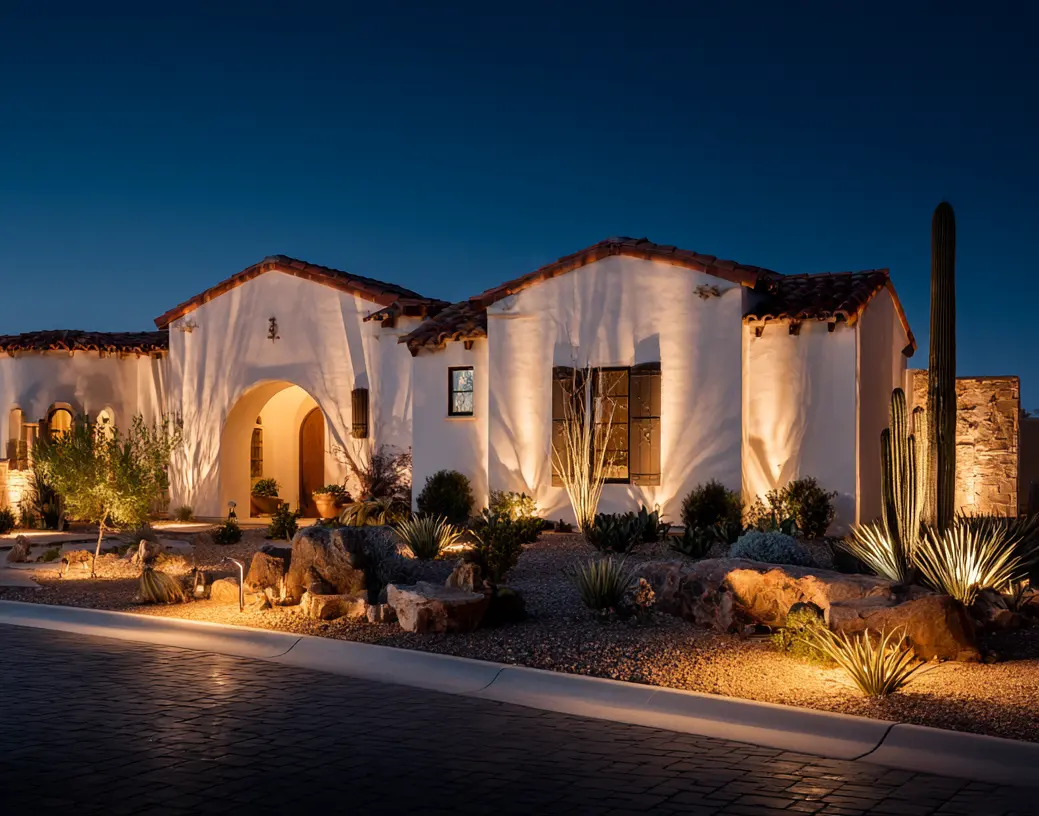
Good lighting shouldn't look like a landing strip. We use a technique called "moonlighting," where we mount fixtures high up in trees (like a mature Mesquite or Palo Verde) and aim them down through the branches. It creates soft, natural shadows on your driveway or patio that look like a full moon is out every night.
Heavy Metal Only
We don't do plastic. Our fixtures are solid brass or aircraft-grade aluminum. Why? Because these materials actually dissipate heat. In the desert, a fixture that stays cool is a fixture that lasts a decade. Plus, they patina beautifully over time, blending right into your desert rock or mulch.
The "Waterproof" Myth
Most people think "waterproof" wire nuts are enough. They aren't. We use grease-filled, heat-shrink connectors that create a permanent, airtight seal. Even if your irrigation system douses the connection every morning, the electricity stays bone-dry.
Why Licensing Actually Matters (ROC# 340142)
We get it—everyone has a "guy" who can do it cheaper. But outdoor lighting is an electrical system connected to your home’s main power. Being a licensed and bonded contractor in Arizona isn't just a badge; it's a guarantee that we won't overload your transformer or create a fire hazard near your foundation.
Beyond safety, a pro install adds real, appraised value to your home. When a buyer drives by at 8:00 PM and sees a perfectly highlighted architectural peak or a glowing backyard oasis, they aren't just seeing lights—they’re seeing a premium property.
Ready to Stop Replacing Your Lights Every Year?
You spent a lot of money on your home and your landscaping. Don't let it disappear the moment the sun goes down. Whether you’re looking for better security, a safer walkway, or just want to be "that house" on the block that looks incredible at night, we’re here to help.
Click here to get a free, zero-pressure consultation from a team that actually lives and works right here in the Valley. Let’s build something that survives the summer.