
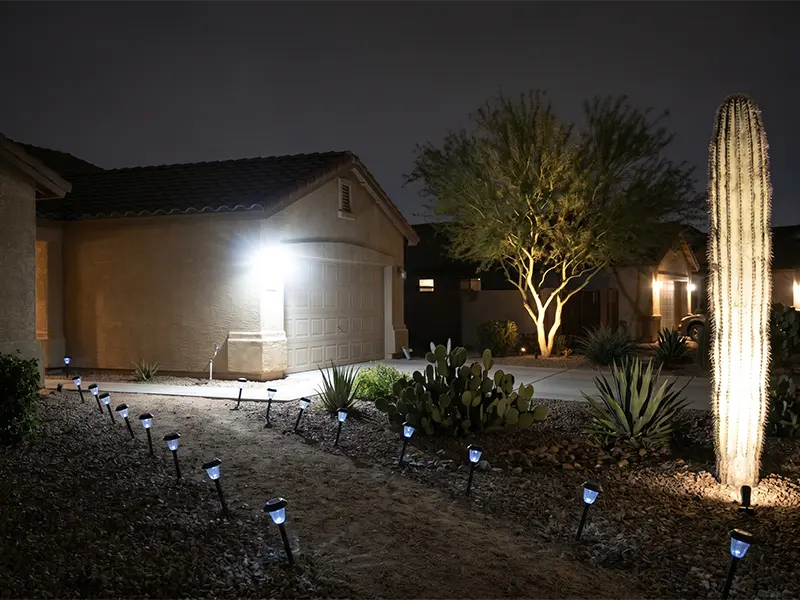
re so caked with dust they're barely putting out any light. This is the number one thing I see when I pull up to a house in Mesa or Gilbert for a consultation. Beautiful yard, nice pavers, and then just... a sad row of dim plastic sticks along the walkway. You're basically re-buying those every six months. That's not a deal. That's a subscription to garbage.
But OK, let's talk about the stuff that actually makes me cringe. The glare bomb. You know exactly what I'm talking about. Some massive floodlight bolted to the side of the garage that blinds you the second you pull into the driveway. That's not landscape lighting. That's a police interrogation. Good lighting — like actually good lighting — you shouldn't even be able to see where it's coming from. You just see the effect. The glow on the wall, the shadow from the tree, whatever. The fixture itself should disappear.
Speaking of trees. If you've got a Saguaro — and if you're in Gilbert you probably do — please stop burying the uplight right at the base of it. I see this constantly. The light just blasts the bottom of the trunk and the whole top half of the cactus is just dark. You gotta pull the fixture back. Give it some distance. Use a narrower beam angle so it catches the ribs going all the way up. THAT'S how you get that dramatic silhouette thing that everyone wants. It's not complicated, the light just needs room to do its job.
Here's one that's specific to us out here and I don't think enough people think about it. You put a cheap zinc or steel fixture in your yard right where the irrigation hits it every night? Phoenix water is brutal. Super hard, tons of minerals. That fixture is gonna look like it went through a war in about eight months. Green crusty buildup, corroded screws, the whole thing. When we do installs we're using solid brass or copper — stuff that actually gets better looking over time as it develops a patina. It's one of those things where spending more upfront saves you from replacing everything in a year.
And then there's the roofline, which is where Gemstone Lights come in and kind of change the whole equation. When your accent lighting is up in the eaves instead of on the ground, you don't have to worry about the landscaper running over a fixture with the mower. Or the dog knocking it sideways. Or the irrigation corroding it. It's just up there, out of the way, doing its thing.
OK this one drives me nuts. People who wire every single light to one switch and just blast everything at full brightness all night long. Your whole yard is just... flat. Same brightness everywhere, no depth, no contrast, nothing interesting going on. The Gemstone app lets you zone things out though — drop your pathways down to maybe 50% so you can see where you're walking, crank the accent lights on the trees up higher, keep the roofline on a soft glow. Now your yard actually has layers to it. It feels like somebody planned it instead of just flipping a switch and walking away.
Color temperature is the other thing that separates a professional-looking yard from a DIY one and most people don't even know what I'm talking about when I bring it up. So like — you've got cool white solar path lights, a warm yellowish porch light, and then maybe some random LED spots that are somewhere in between. It looks like three different people did your lighting on three different weekends. Because they did. Gemstone runs from 2800K all the way to 7000K so you can match everything to one consistent tone. That warm 2800K across the board is what gives you that Scottsdale resort vibe. It sounds like a small thing but it's honestly the difference between "oh nice lights" and "wow this looks incredible."
Monsoon season is the real test though. I've seen those cheaper systems with the little push-fit connectors just get wrecked after one good storm. Wires pull out, lights go dark, the whole thing sags off the fascia. Gemstone uses threaded compression connectors — they're watertight and they don't care about wind. The tracks themselves are aluminum bolted into the structure. I had a customer in east Mesa ride out a microburst last summer and text me the next morning like "everything still works." Yeah. That's the point.
Last thing and then I'll shut up about it — just because you CAN put a light every two feet doesn't mean you should. Some of the best-looking yards I've done have big stretches of darkness between the lit areas. The shadows are part of the design. You want contrast. You want people's eyes to move from one pool of light to the next, noticing the architecture, the plants, the texture of the stone. If you light up every square inch it just looks like a car dealership. Nobody wants their house to look like a car dealership.