
Got a call from a guy in Fountain Hills back in the spring. He was pretty worked up. He’d put in landscape lighting himself, big weekend project, and somebody had said something to him about the dark sky ordinance and now he was convinced he was going to have to pull the whole thing back out of the ground.
He didn’t have to pull it out. We adjusted maybe six fixtures and he was fine.
But I get some version of that call a few times a year and there’s a ton of confusion out there, so let’s talk about it.
Nobody is telling you that you can’t have lights
This is the part people get wrong before anything else. Dark sky rules are not “no outdoor lighting.” They’ve never been that. If they were, there’d be no streetlights in Fountain Hills and there are.
What they actually care about is where the light goes. That’s it. That’s the whole thing. Light that goes down onto your walkway, your plants, your driveway — that’s fine, that’s the point of lighting. Light that goes sideways into your neighbor’s bedroom window or straight up into the sky doing nothing for anybody is the problem.
Once you understand it that way most of the rules stop being mysterious.
Fountain Hills is actually a certified International Dark Sky Community. Officially. They went and got the designation and they’re proud of it, and honestly they should be — go stand outside up there on a clear night in January and you’ll see why. Paradise Valley has its own thing going, no streetlights at all by design, and their standards are strict. Cave Creek and Carefree aren’t formally certified but the whole culture up there is the same. People moved out there for the sky and they’re not interested in giving it up.
The three things that actually matter
Shielding. Aiming. Brightness.
Shielded means the fixture has something over the top of it so light can’t escape upward. Most decent landscape fixtures already do this, which is why a lot of people are compliant without knowing it. The cheap ones from the big box store, the ones that look like a little tulip on a stake — a lot of those throw light in every direction including straight up. Those are the ones that get you in trouble.
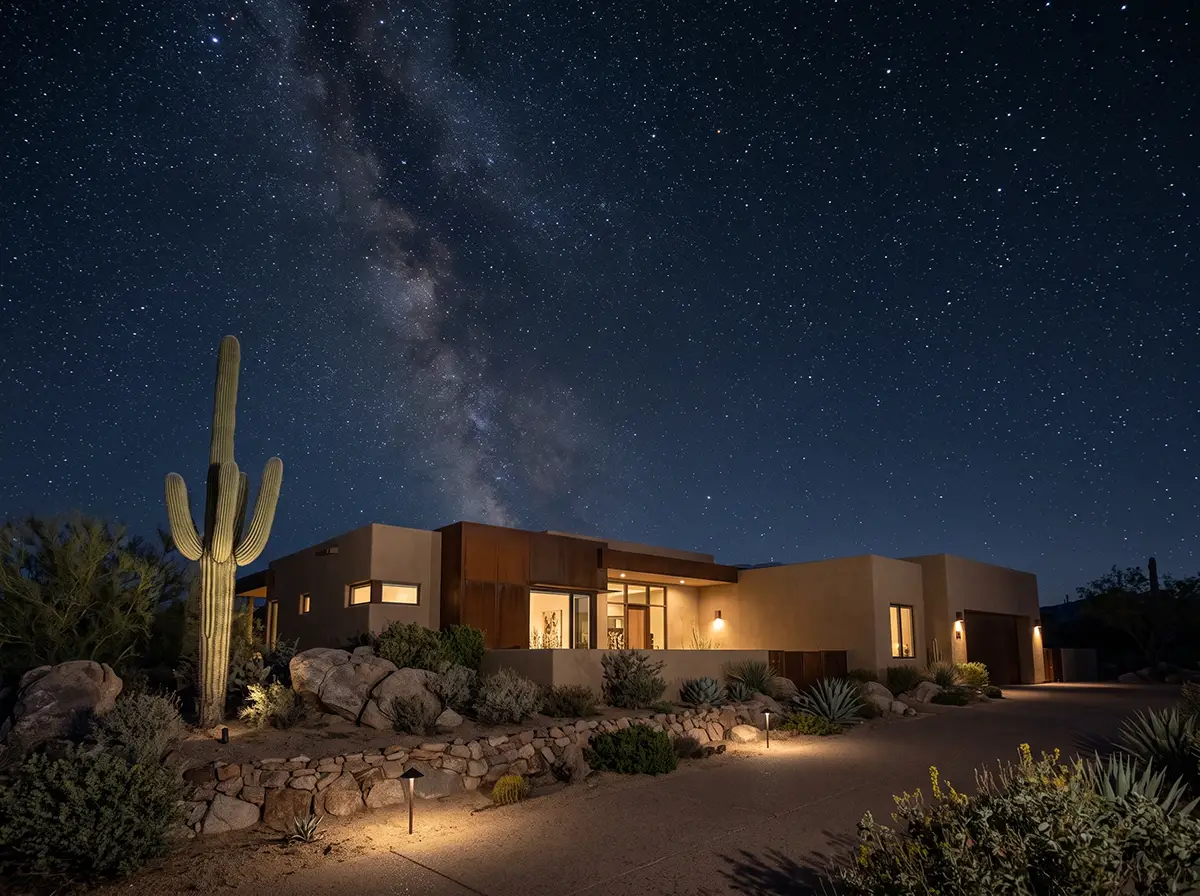
Aiming is where I spend most of my time on a dark sky property. You can have the perfect fixture and if it’s pointed wrong it’s a floodlight. Up-lighting a saguaro, for example — you want that beam tight and you want it hitting the cactus, not shooting past it into the air. Sounds obvious. You’d be amazed.
And brightness. This is the one people fight me on and it’s the one where I’m most confident I’m right, so hear me out.
Less light looks better anyway
Here’s the thing about a dark sky area that people don’t figure out until they see it done: you need way less light than you think.
Your eyes adjust. In central Phoenix, with all that ambient glow, you have to push a decent amount of light to make a plant read at night, because it’s competing with everything else. Out in Fountain Hills or Cave Creek there’s nothing to compete with. The background is genuinely black. So a modest little up-light at the base of a saguaro looks dramatic — like stage lighting. Same fixture in Arcadia would barely register.
I’ve had customers ask me to turn things down after the first night. Never had one in a dark sky area ask me to turn it up.
So the restraint the ordinance asks for isn’t a compromise. It’s the thing that makes it look expensive. Over-lit yards look cheap everywhere, but out there they look really cheap, and they look like somebody didn’t know what they were doing.
Permanent trim lighting and dark sky — this comes up a lot
People assume roofline lighting is automatically a problem in these areas. It isn’t, but it depends entirely on what you install and how.
The systems we put in use shielded diodes sitting in a track that’s tucked up under the fascia. The light is aimed down and outward at the house. It’s not spraying upward. And it’s dimmable, so we can bring the level down to where it outlines the architecture without lighting up the neighborhood.
Compare that to a strand of C9 bulbs clipped along the gutter, which throws light in a full 360 degrees, half of it straight into the sky. That’s the thing dark sky rules were written about. Permanent trim done properly is the better answer, not the worse one.
I’ve installed in Fountain Hills, up in Carefree, out on the hillside lots. Never had one come back as a problem. But I also read the local requirements before I spec anything, which brings me to the part I actually want to say.
Just ask before you buy
If you’re in one of these areas — Fountain Hills especially, Paradise Valley definitely, and I’d say Cave Creek and Carefree too even though it’s less formal — talk to somebody who’s worked there before you spend money.
Not because it’s complicated. It’s not that complicated. But because the difference between a compliant install and a non-compliant one is usually a couple of fixture choices and about fifteen degrees of aim, and it’s a lot easier to get those right the first time than to go back and redo it.
The guy who called me in the spring did fine. Six fixtures, an afternoon. But he’d already spent a full weekend putting the system in, and if he’d asked first he’d have spent that weekend once instead of twice.
That’s really it. The rules aren’t there to stop you having a beautiful yard at night. They’re there so that when you’re standing in that beautiful yard, you can still look up.
We install landscape and permanent trim lighting throughout Fountain Hills, Cave Creek, Carefree, Paradise Valley and the rest of the Valley — and we design to local requirements before anything goes in the ground. Free after-dark design visit, no pressure. Give us a call at (480) 809-7800.