
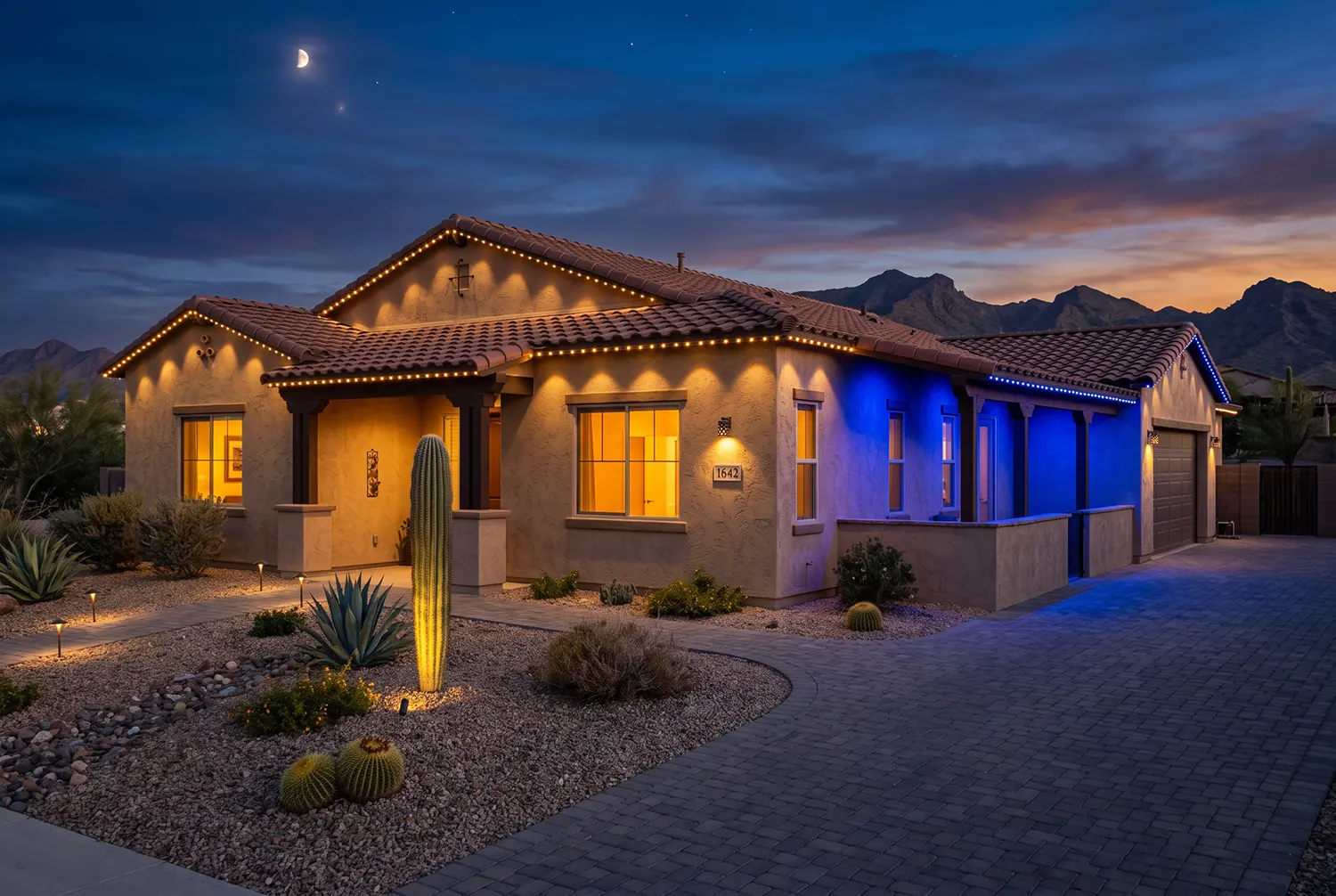
When I'm demoing permanent trim for somebody, the app is usually where I lose them for a second. I'll pull out my phone and start swiping through colors on their own roofline, and there's this little pause while they work out that the thing does quite a bit more than they were picturing.
Then a fair number of them get a little suspicious about it, usually because some smart home gadget has let them down before, and I don't blame anybody for that at all. Everybody's got a story about a thermostat that stopped talking to their wifi or a video doorbell that needed its app replaced. So I'd rather just walk through what people really end up using on these, and I'll be upfront about the parts that get played with for a week and then never touched again.
Scheduling, which is the actual killer feature
This is the boring one, and it's the one that matters most.
You set the lights to come on at sunset and go off at whatever hour you pick, and then you never think about it again. Not a clock time either, sunset specifically, which shifts every day of the year. In Phoenix that swing is real. Sunset moves from around 5:20 in December to past 7:40 in June, and a system running on a fixed clock time is wrong for most of the year.
Coming on right at sunset is often too early, because there's still plenty of light in the sky and the roofline just looks washed out and faint. Most of my customers end up somewhere around twenty or thirty minutes after sunset, once the sky has actually gone blue. That's the window where the lights suddenly look like something.
The off time is more personal and some people run until midnight, some shut down at ten, and a few leave the front on all night because they like coming home to a lit house. There's no right answer, though I'd say if you've got neighbors whose bedroom windows face your place, be a decent human about the back patio.
People underestimate all of this because it isn't flashy. But it's the feature that makes the whole system feel effortless instead of like one more thing to manage. My customers who've had trim for a few years mostly interact with the app a handful of times a year, and that's the system working correctly.
Zones, which sound boring and aren't
Zones let you control different runs separately. Front roofline, back patio, garage side, whatever divisions make sense for your house.
Where this earns its keep is that you almost never want the whole house doing the same thing. Come Christmas you might want red and green across the front where the street sees it, and warm white in back where you're actually sitting, because eating dinner under flashing red and green gets old fast.
I've got a customer in Gilbert whose setup I think about a lot as the good example. Her front roofline runs a schedule she basically never changes. The back patio is on its own zone that she turns on when people are over and leaves off the rest of the time. And the garage side, which faces her neighbor, she keeps at a low warm white year round so it's functional without being a light show pointed at somebody's house. Three zones, three completely different jobs, one system.
Nobody has ever once asked me about zones before buying a system. Then a year in it's one of the things people bring up on their own, which I've always found a little funny.
Worth knowing at design time: zones get decided when we lay out the runs, not afterward. Splitting a zone later usually means pulling the channel and rerunning it. So if you have any sense that you'd want the back separate from the front, say it during the design walk and it costs you nothing.
Scenes, where it gets fun
A scene is just a saved setup. Colors, pattern, brightness, all stored under a name so you can pull it up in one tap instead of rebuilding it.
Most people end up with somewhere between five and ten that they actually use, and the list is fairly predictable. There's a warm white one for everyday, something for Christmas, usually orange and purple around Halloween, red white and blue in the summer, and team colors if anybody in the house cares about a team. Then there's normally a personal one or two on top of that, a birthday or just a color somebody in the family likes.
The everyday warm white scene is the one that surprises people. They buy the system imagining holidays and then discover that the version they run 300 nights a year is a plain warm white line along the roof that makes the house look like it belongs in a magazine. I'd guess that's the most-used scene across every customer I have.
One practical thing about building scenes. Do it at night, standing outside, looking at your actual house. Everybody's first instinct is to sit on the couch and pick colors off the phone screen, and the colors never look the way you expect once they're forty feet up on stucco. Tan stucco in particular will pull a lot of colors warm, so the crisp blue you picked on the screen lands somewhere closer to teal. Ten minutes in the driveway saves you a lot of fiddling.
The part nobody asks about, which is where the controller lives
Here's something that never comes up in a sales conversation and absolutely should, especially here.
The controller is a small piece of electronics that has to live somewhere outside, usually near the transformer or tucked up under an eave. Which means it spends its life in Arizona. We put ours in shaded locations wherever the run allows, in enclosures rated for outdoor use, because a controller baking in direct west-facing sun through August is a controller with a shortened life. This is one of those things that separates installs that are still working in year seven from the ones that aren't.
The other half of it is wifi. Your router is probably in an office in the middle of the house, and the controller is out at the roofline behind a couple of stucco walls, and stucco has wire mesh in it that eats wifi signal. I've seen systems that worked perfectly during the demo and then dropped constantly once everybody went inside and the house filled up with other devices. Worth asking whoever installs yours how they're going to verify signal strength at the controller rather than at the front door.
The first week, honestly
Expect to overuse it. Everybody does, and it's fine.
The first several nights people cycle through every color in the app, try the patterns, show the neighbors, change it three times in an evening. I've had customers text me photos at eleven at night. Then somewhere around week two or three it settles down, they land on their handful of scenes, and the system fades into being part of the house.
We set the initial schedule and build the first few scenes with you on install day so you're not starting from a blank app. But I'd tell you to give it a few weeks before deciding you've got it dialed in, because what you think you want on night one and what you actually run in March are usually different things.
Now the honest part about the gimmicks
There are features in these apps that exist to look good in a showroom.
Chase and twinkle patterns are the big one, where the lights animate and run along the roofline. They're a lot of fun for about four days, and then your neighbors start quietly wondering when it's going to stop, and honestly so do you. I'm not saying never do it, because a slow chase on Christmas Eve is genuinely charming, but I've yet to meet anybody who ran animation year round and stayed happy about it.
Music sync is the other one people get excited about. It works fine and it's a legitimately cool party trick, and I think I've watched somebody actually use it twice. If a person is picking between systems based on whether the lights dance to Mariah Carey, I usually try to redirect them toward thinking about build quality instead.
What actually makes people glad they bought the thing is much duller than any of that. It's the schedule running correctly every single night without being asked, and having the zones set up in a way that matches how you use the house, and being able to find the four or five scenes you care about without hunting through a menu.
What to ask before you buy anything
A few things I'd want to know if I were shopping, regardless of who you end up hiring.
Find out whether it runs on your local wifi and whether it keeps working when your internet drops, because a system that goes dark on you just because the provider is having a bad night was designed badly. The specific question worth asking is whether the schedule lives on the controller itself or up in the cloud somewhere.
I'd also ask whether more than one person in the house can control the thing or if it's all tied to a single phone. That sounds like nothing when you're standing there buying it and turns into a real irritation about six months later when you're out of town and somebody at home wants the lights off.
Ask about Alexa or Google if you use either one, since support varies a lot between brands and some of it is pretty half-baked. It's a nice extra when it works properly. I wouldn't buy a system for it.
Then ask how firmware updates happen, and whether they've ever pushed one that broke something. Any honest installer will tell you yes, because everybody in this industry has had a rough update at some point. What you're really listening for is how fast it got sorted out.
And find out what happens to the app if the company behind it goes under, which in this industry is not remotely hypothetical given how many brands have come and gone in the past few years. You want to know whether you'd be left with a working system on your house or just a very expensive run of dead LEDs up under your fascia.
Anyway
The app is genuinelywhat t makes permanent trim worth owning rather than just a fancier version of Christmas lights. It's also the part where the marketing gets loudest and least useful, so it's worth going in knowing which questions matter.
I'm happy to just show you all of it. It's a lot easier to understand standing in front of a house with the lights on than reading about it, and honestly the demo is my favorite part of the job.
— Sam
Desert Outdoor Lighting has served the Phoenix Valley since 2004. Licensed and bonded, ROC# 340142. Get in touch for a free after-dark design visit and I'll run you through it on your own roofline.