

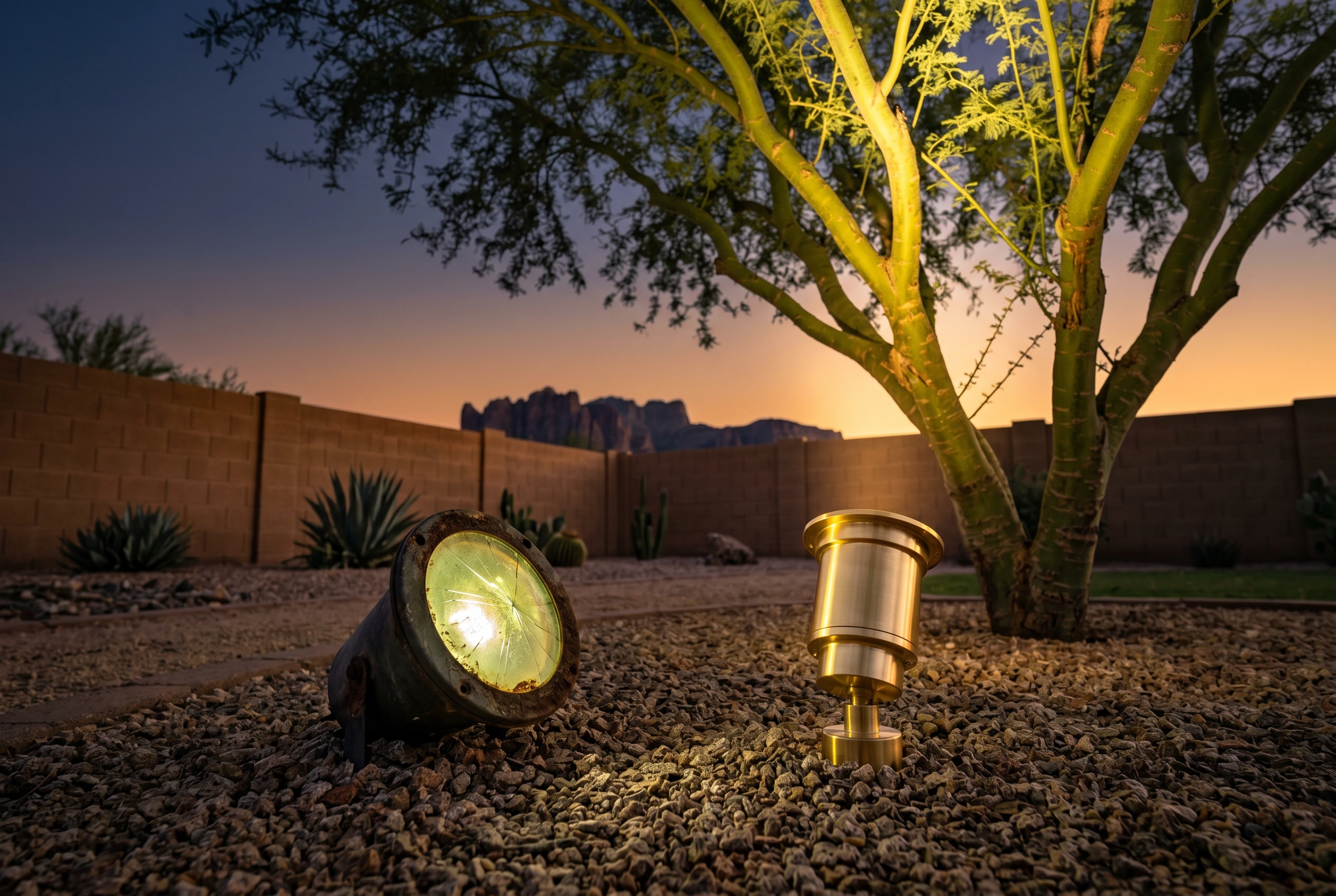
I'm going to date myself here but when I first started doing landscape lighting the standard was halogen MR16 bulbs in every fixture. That's just what everyone used. Brass fixture, halogen bulb, 12 volt transformer, done. And honestly they looked great. Halogen puts out this warm rich light that's hard to argue with. The color rendering is beautiful.
But we stopped installing them. Completely. Haven't put a halogen bulb in the ground in years. And it wasn't because some sales rep talked me into switching. It was because I got tired of going back to the same houses every 8 to 14 months to replace burned out bulbs.
Halogen and Arizona Heat Is a Bad Combination
Here's the fundamental problem. A halogen bulb operates by heating a tungsten filament to extremely high temperatures. The bulb itself gets scorching hot. Like burn your hand if you touch it hot. Now put that inside a sealed fixture that's sitting in decomposed granite in a yard where the ambient air temperature is 115 degrees and the ground surface is probably 140 or 150.
You're basically cooking an already hot bulb inside an oven. The lifespan of a halogen MR16 is supposedly around 4,000 to 5,000 hours. In Arizona? I was seeing them burn out in 2,000 hours or less regularly. Some even faster depending on where they were placed. South facing rock beds were the worst. I'd install brand new bulbs in October and be back replacing them by the following August.
That's not a maintenance schedule anyone wants to deal with. Especially when you've got 15 or 20 fixtures in a yard and you're playing whack a mole with dead bulbs every few months.
And the heat from the bulb itself was causing other problems. The rubber gaskets and seals inside cheaper fixtures would deteriorate faster. Wire connections near the fixture socket would get brittle. I even had instances where the heat from the halogen discolored the finish on fixture housings. All stuff that just doesn't happen with LEDs.
The LED Switch Wasn't Instant Though
I should be honest about this. Early LED landscape lighting was not great. The first generation stuff I tried, probably around 2012 or 2013, had terrible color. Very blue. Very cold. People would look at it and say that looks cheap compared to the warm halogen glow they were used to. And they were right. It did look cheap.
The other issue was the integrated LED fixtures where you couldn't swap the bulb. If the LED module died you had to replace the entire fixture. Which felt wasteful and expensive. People didn't love hearing that.
But the technology caught up fast. The LEDs we're installing now put out light in the 2700K range that is virtually indistinguishable from halogen. I've done side by side comparisons for skeptical customers and most of them can't tell which is which. The warmth is there. The richness is there. It looks right.
And the fixtures have gotten way better about being modular. Most of what we use now has a replaceable LED module. If something does fail ten years from now you swap the module for like $20 instead of replacing a $150 fixture. That's a big deal.
The Numbers Aren't Even Close
Let me just throw some basic math at you because this is where it gets kind of ridiculous.
A typical halogen MR16 lamp runs at 20 to 50 watts depending on what you need. Most installs used 35 watt or 50 watt bulbs. An equivalent LED puts out the same amount of light at 3 to 8 watts. So right off the bat your power consumption drops by like 80 percent. In a system with 20 fixtures that's a meaningful chunk off your electric bill every month.
Then there's the bulb replacement cost. At $5 to $8 per halogen bulb and replacing maybe a third of your system every year in this climate, you're spending $30 to $50 a year just on bulbs. Plus either your time crawling around the yard swapping them or paying someone to do it. Over ten years that adds up to way more than the cost difference between halogen and LED fixtures at install.
And the LED lifespan? We're talking 40,000 to 50,000 hours rated. Even if you cut that in half for Arizona heat conditions that's still 20,000 plus hours. Versus the 2,000 I was getting out of halogen here. It's not even a comparison.
The Transformer Situation Changes Too
This is something people don't always think about. Because LEDs draw so much less power, your transformer doesn't have to work nearly as hard. A 600 watt transformer that was running at near capacity with 20 halogen fixtures is suddenly only handling like 100 watts with the same number of LED fixtures.
That means the transformer runs cooler. A lot cooler. And in Arizona where transformer overheating is one of the most common system failures I see, that matters enormously. A transformer that's loafing along at 20 percent capacity is going to last way longer than one that's been grinding at 80 percent capacity in 115 degree heat for years.
It also means if you want to add more fixtures later you've got tons of headroom on your existing transformer. Want to add path lights to the front walkway? No problem, the transformer can handle it. With halogen you'd probably need to upgrade the transformer to add more fixtures. More cost, more work, more heat generation.
When People Push Back
I still get the occasional customer who's had halogen for years and loves the look and doesn't want to change. And I get it. Change is annoying especially when the thing you have seems to be working. But usually once I explain the replacement cycle and the energy savings they come around. And then once they see the side by side light quality comparison that's pretty much the end of the conversation.
The only scenario where I'd even consider halogen at this point is some very specific commercial applications where a particular beam spread or color temperature isn't available in LED yet. And even those gaps are closing fast. For residential landscape lighting in the Phoenix area there's just zero reason to go halogen anymore. Zero.
If you've got an older halogen system that you're constantly replacing bulbs in, a retrofit to LED is one of the best value upgrades you can do. You keep your existing fixtures and transformer in most cases, just swap the lamp modules. The payback period is usually under two years just in bulb and energy savings. After that it's basically free money.
Hit me up if you want to talk about converting your system. It's usually a pretty straightforward job.