
Every so often somebody sends me a link to a landscape light on Amazon that costs about twelve dollars and asks if we can just use those. I get why. If you're lighting twenty spots in the yard and the fixture I'm quoting costs several times that, the math jumps right off the page and it looks like I'm padding the bill.
I'm not, though, and this is basically the long version of what I end up saying on the phone.
The twelve dollar fixture
Most of the cheap ones are either plastic or thin cast aluminum with paint or powder coat on the outside. Back in Ohio that might hold up for a good while. Out here they have a very particular way of dying, and I've pulled enough of them out of yards in Gilbert and Chandler that I could almost tell you which summer they started going.
It usually starts with the finish.
What our sun does to aluminum and plastic
Plastic is the easy one to explain. UV breaks it down, so a fixture that spends five or six summers in direct sun goes chalky and then brittle, and one day somebody bumps it with a hose and it snaps right off at the stake. I've had customers hand me the pieces.
Aluminum takes longer and the problem is mostly the coating. The powder coat gets baked every afternoon and cooled off every night, and after a few years of that it starts chipping, especially where the sprinklers hit it or where the landscaper's string trimmer catches it every other week. Once bare metal is showing it oxidizes, and the threads where the cap or the lens screws on start seizing up, so you can't open the thing to service it without breaking something. Our water is hard enough to leave white crust on everything it touches and that doesn't help at all.
And a fixture you can't open is a fixture you throw away.
Why brass and copper hold up
Solid brass and copper don't have a coating to fail. The metal is the same all the way through, so there's nothing to chip off, and the threads stay workable for years because nothing is corroding into them. I can go back to a brass fixture we set a decade ago, unscrew the cap, swap the LED and be done in a couple minutes, and I do that pretty regularly on older jobs.
They're heavier too, which sounds like nothing until a monsoon wind comes through or somebody's dog decides a path light is a chew toy. The heavy ones stay aimed where you left them.
About the color change
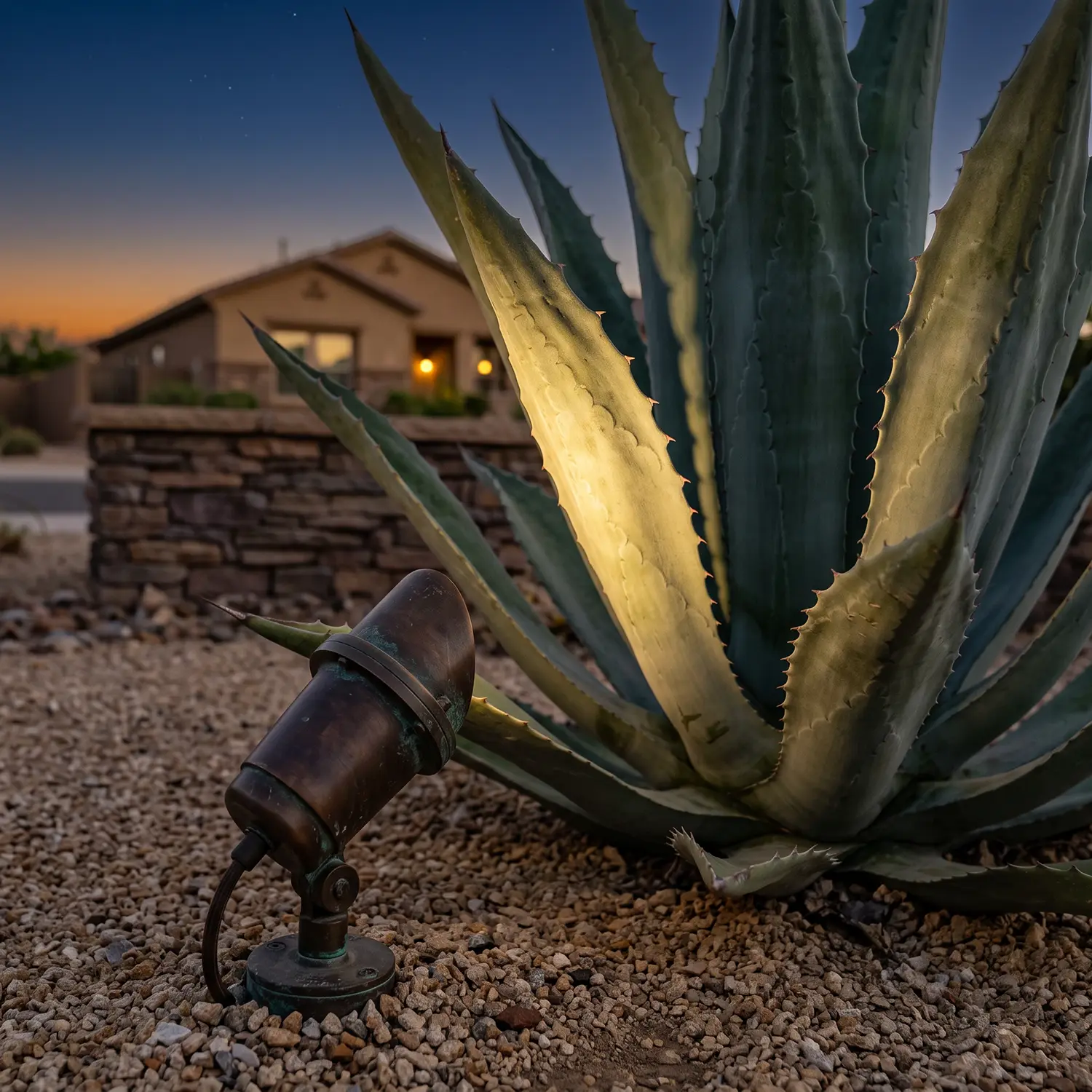
People ask about this so I'll just cover it. A new brass fixture comes out of the box shiny and kind of gold, and within a year or so out here it goes dark brown and then starts heading toward that soft greenish patina, with copper doing roughly the same thing on its own schedule. Some folks get worried the first time they notice. That's just the metal protecting itself, and honestly I think it looks better, because a dark weathered fixture sitting in the granite next to an agave pretty much disappears during the day, which is the goal, since the only thing anybody should notice at night is the light itself.
If you really want it to stay shiny you'd be out there polishing it every few weeks for the rest of your life. I don't know anybody who does that.
Is it worth the extra money
For most people yes, but there's one case where I'll tell you it isn't. If you're selling the house in a year or two and you just want the yard looking good for the listing photos, a decent mid-grade aluminum fixture will get you there and I'll say so on the visit.
For a house you're staying in, a brass fixture costs more the one time you buy it and after that it mostly just sits out there working, whereas the cheap ones tend to need replacing somewhere around year three or four and then again a few years after that, with somebody's labor to dig each one out and set a new one every time. I've done that math with customers at their kitchen table and it doesn't take long before the expensive fixture comes out ahead, usually well inside the life of the first set. It's the same reason we stopped installing halogen years ago.
The few times I let somebody talk me into cheaper hardware I ended up back at that house replacing it and wishing I'd pushed a little harder.
— Sam
Desert Outdoor Lighting has served the Phoenix Valley since 2004. We're licensed and bonded (ROC# 340142) and install landscape lighting and Gemstone permanent trim lighting in Gilbert, Mesa, Chandler, Scottsdale, Tempe, Queen Creek and across the Valley. Call (480) 809-7800 or request a free after-dark design visit.