
Lighting a Fountain, Water Wall or Fire Feature So It Looks Right at Night
When somebody spends a lot of money on a water feature, a cast stone fountain or a sheet waterfall coming off a block wall, it's usually the centerpiece of the yard during the day. Then the sun goes down and it turns into a sound coming from somewhere in the dark, and I get the call.
Water is one of my favorite things to light. It's also really easy to get wrong.
Light the water, not the structure
Most of the bad water feature lighting I see is an uplight stuck in the gravel a few feet away and aimed at the fountain, so you get a bright fountain and the water itself kind of disappears into the glare. What makes water look good at night is light coming through it or across it, so the falling water catches it and sparkles.
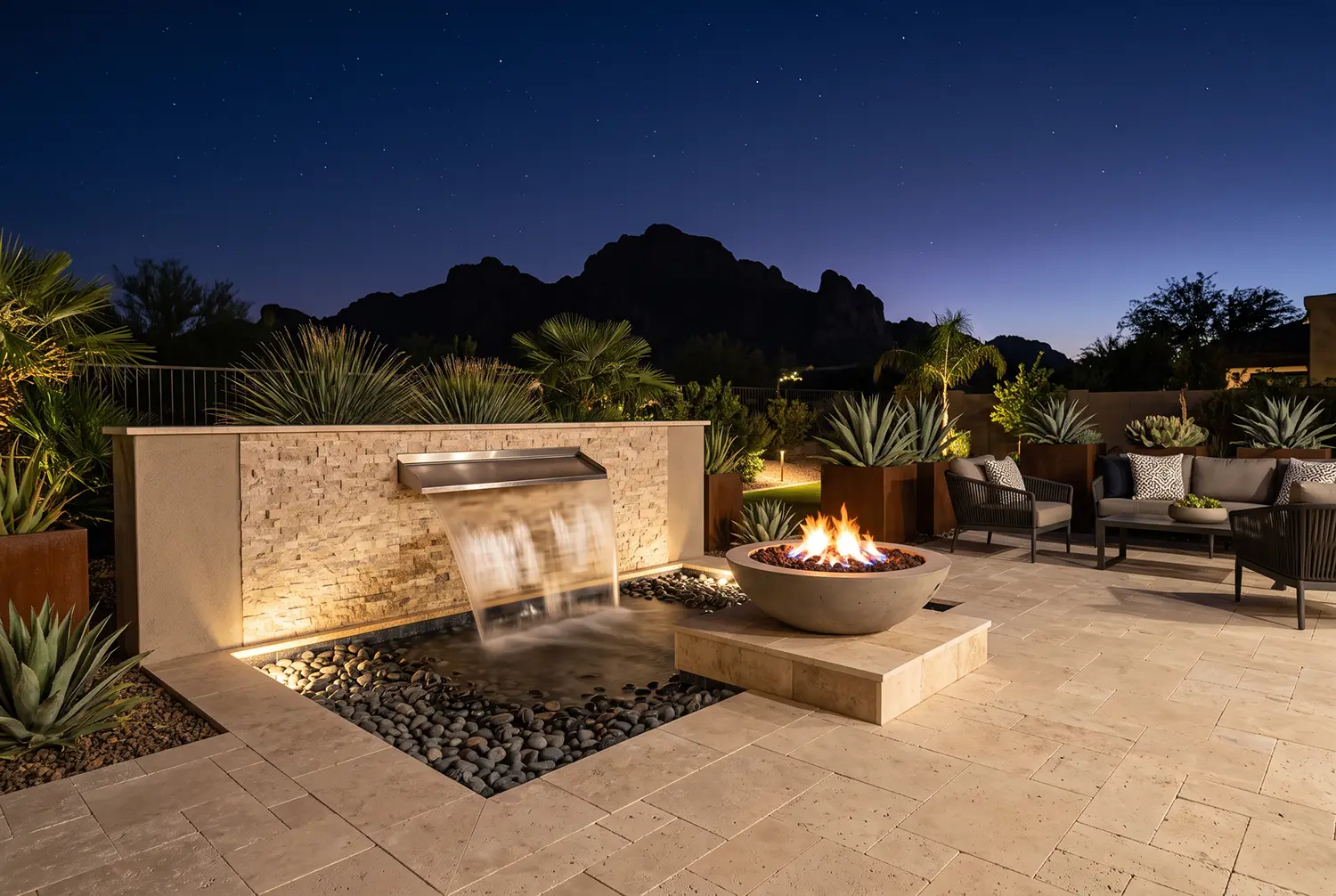
For a sheet waterfall or a water wall, that usually means a light strip or a small fixture tucked right under the lip where the water spills over, or set into the basin underneath and aimed back up at the sheet. Done right, the water looks like it's glowing from inside and you can't see where the light is coming from. For a tiered fountain I'll often put a small submersible fixture in the bowl aimed up through the falling water, and then maybe one soft light from outside to pick up the shape of the stone.
Ponds are their own thing. A light under still water mostly lights up whatever's floating in it, so I tend to light around a pond rather than in it, and let the surface reflect the plants and the sky.
Underwater fixtures have to be made for it
This sounds obvious but I've pulled plenty of regular landscape lights out of fountain basins where somebody figured waterproof was waterproof. A fixture rated for rain is not rated to sit underwater all day, and our water is so hard that a basin fixture needs to handle scale building up on it too. I use solid brass submersibles for this, for pretty much the same reasons I gave in the brass and copper post, and the lenses need wiping every so often because calcium crust dims them faster than you'd expect.
And everything in or near the water is low voltage, always. That's not really a preference.
Fire features are a different conversation
A fire pit or fire bowl makes its own light, and a lot of people want to light it anyway. Mostly I'd say don't, at least not directly. A bright light aimed at a fire bowl kills the whole reason you have one.
What I do is light around it, with low warm light on the seating and the walk out to it so people aren't tripping over chair legs on their way to the fire, and keep that on a dimmer or a separate zone so you can turn it way down once the fire's going. The fire should be the brightest thing in that part of the yard. If a gas fire bowl sits on a pedestal, a little grazing light on the column can look nice when the fire's off, but it should be a separate zone so it can go off when the fire is lit.
Heat matters here too. Fixtures need to be far enough away from the burner that they're not getting cooked, and the wire runs need to stay clear of where the gas line goes, which means coordinating with whoever installed the fire feature.
Pools and features together
A lot of yards in Scottsdale and Paradise Valley have a pool with sheer descents or scuppers coming off a raised wall, or a fire bowl sitting on the pool edge. Those get lit as part of the pool design, and I covered the basics of that in the pool lighting post. The big thing is that the pool light and the feature lights should match in color temperature, or at least look like they belong in the same yard. A cold blue-white pool light next to a warm scupper light looks like two different houses.
— Sam
Desert Outdoor Lighting has served the Phoenix Valley since 2004. We're licensed and bonded (ROC# 340142) and install landscape lighting and Gemstone permanent trim lighting in Gilbert, Mesa, Chandler, Scottsdale, Tempe, Queen Creek and across the Valley. Call (480) 809-7800 or request a free after-dark design visit.