
If you've lived in the Valley long enough you've probably had this experience. You install outdoor lights, they look great for a while, and then stuff starts failing. A fixture goes dark. Then another one. The path lights get dim. One of them starts flickering like a horror movie. Eventually half your system is dead and the other half looks rough. And you're standing in your yard at 9pm going what the hell happened, I just had these installed like two years ago.
I get calls about this constantly. People who had lights put in by a handyman or a landscaper or even another lighting company and now things are falling apart. And almost every time the root cause is one of the same handful of issues. So let me walk through what's actually killing your lights out here because once you understand it, most of it is either preventable or fixable.
UV Damage Is the Silent Killer
People think about heat when they think about Arizona being tough on stuff. And yeah the heat is a factor. But UV radiation does more damage to outdoor lighting than the heat does. We get something like 300 days of sunshine a year in Phoenix. That's 300 days of UV bombardment hitting every exposed surface in your yard.
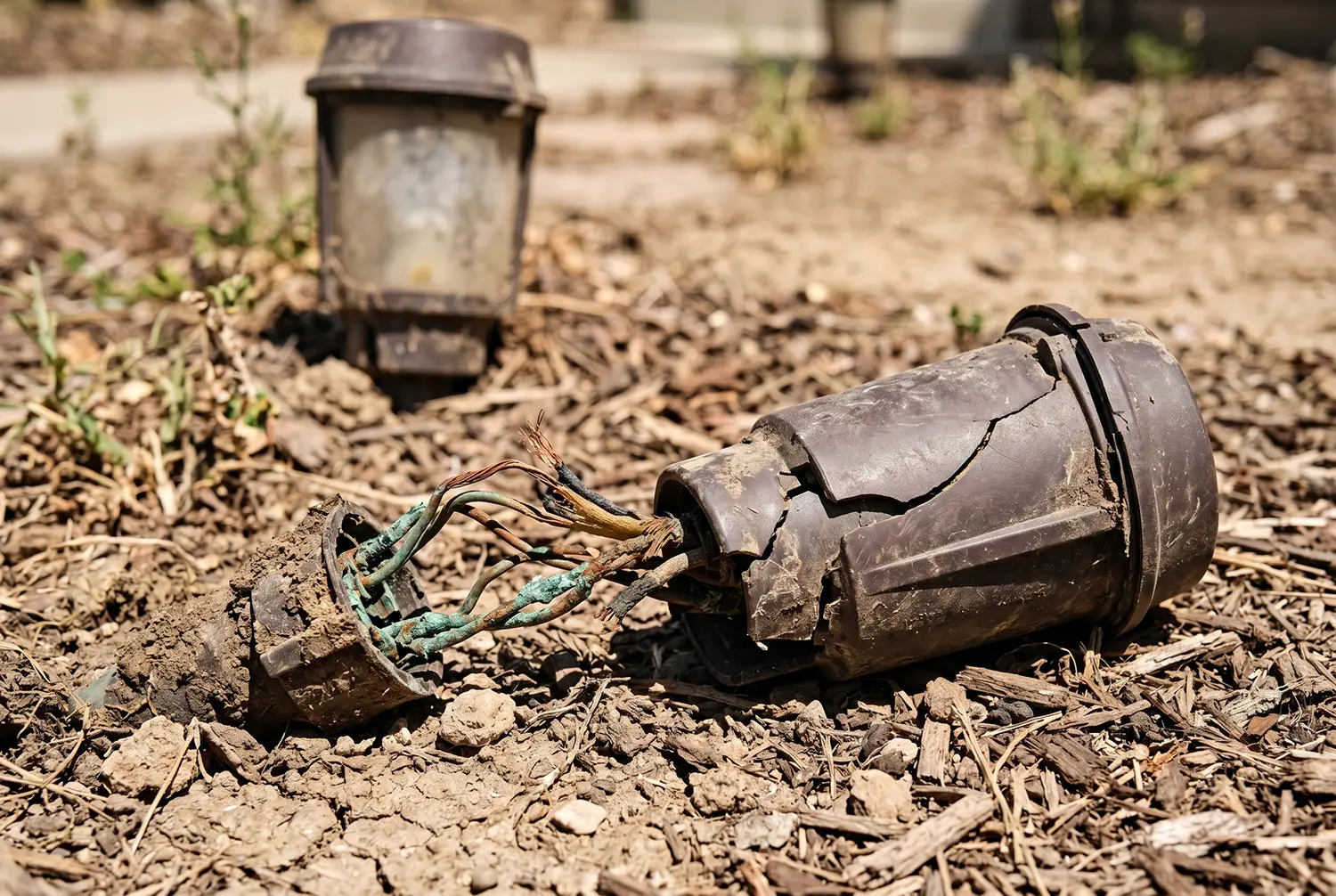
Cheap plastic fixture housings are the first casualty. That composite or polymer housing that looked fine at the store turns chalky and brittle within a couple of years. The lens fogs up. Then it cracks. Once the housing is compromised, moisture gets in during monsoon season and that's it. The internal electronics corrode, the socket rusts, the whole fixture is done.
I've pulled fixtures out of yards that literally crumbled in my hand. The plastic was so degraded from UV that it had no structural integrity left. And these weren't ancient fixtures. Two, maybe three years old. Whatever the manufacturer rated them for, they weren't testing in the Sonoran Desert.
This is the single biggest reason I use brass and copper fixtures instead of anything with plastic or painted aluminum. Brass doesn't care about UV. It develops a patina over time which actually looks better, and it stays structurally sound for decades. Painted aluminum is a middle ground but even good powder coat finishes will eventually start flaking under our UV exposure. I've seen fixtures where the paint peeled so badly the bare aluminum underneath was pitting from exposure.
Bad Connections Are the Number One Repair I Do
When I show up to troubleshoot a system that's partially failing, my first move is always checking connections. And I'd say 60 to 70 percent of the time that's where the problem is. Either a wire nut that wasn't rated for direct burial. Or a connection that was just twisted together with electrical tape. Or a gel filled connector that got installed wrong and didn't actually seal.
Here's what happens. The connection works fine initially. Then Arizona happens. In summer the ground heats up and everything expands slightly. In winter it contracts. Monsoon season floods the rock beds and submerges everything in muddy water. Dust works its way into any gap. Over a couple of these cycles a marginal connection starts to corrode. Copper wire turns green. Resistance builds up at the connection point. The fixture on that run gets dimmer. Eventually the corrosion breaks the connection entirely and the fixture goes dark.
The frustrating part is this is completely preventable. Proper waterproof connectors installed correctly will last the life of the system. We use gel filled connectors on every single connection and we make sure they're fully sealed before we bury anything. It takes a little more time during install but I'm not coming back in 18 months to dig up someone's yard looking for a bad connection. That's a waste of everyone's time and money.
Voltage Drop Gets Worse Over Time
OK this one's a little more technical but it matters. In a low voltage landscape lighting system you've got 12 volts coming out of the transformer. As that voltage travels down the wire it drops a little bit with every foot of cable and every fixture it passes. By the time you get to the last fixture on a long run you might only have 9 or 10 volts reaching it.
That fixture is going to be noticeably dimmer than the ones close to the transformer. And as connections degrade and add resistance, the voltage drop gets even worse. What started as a minor difference between the first and last fixture on a run becomes obvious. One end of your yard is bright and the other end is barely glowing.
The fix for this is in the original design. Proper wire gauge for the length of run. Hub connections instead of daisy chaining everything in series. Multiple runs from the transformer instead of one long loop. Stuff that a qualified landscape lighting installer thinks about from day one.
If you've got an existing system with voltage drop issues it can usually be improved by adding a home run wire to the far fixtures or splitting one long run into two shorter ones from the transformer. It's not always pretty because you're pulling new wire through established landscaping but it solves the problem permanently.
The Wrong Fixtures for the Wrong Location
I touched on this with the UV thing but it goes beyond just material quality. Fixtures have different ratings for different conditions and a lot of people don't pay attention to that. Or the person who installed them didn't pay attention.
An IP65 rated fixture is dust tight and can handle water jets. IP67 can handle temporary submersion. IP68 can handle continuous submersion. If you've got fixtures in a rock bed that floods during monsoon season and they're only rated IP65, they might survive a quick rain but sitting in standing water for a few hours is going to get moisture inside.
Fixture placement matters too. A well light, that's the kind that sits in the ground and shoots light upward, those fill up with water when it rains. If the drain hole is clogged with dirt or gravel dust, the fixture is just sitting in a puddle of water until it evaporates. In Arizona that water is mineral heavy. Salt deposits build up. The lens gets cloudy. The socket corrodes. I've seen brand new well lights fail within a year because nobody considered drainage.
I'm not a huge fan of well lights in general for Arizona installs honestly. Between the flooding issue and the fact that they sit at ground level where landscape crews can kick gravel into them or run over them with a mower, they just have a higher failure rate than above ground fixtures. There are situations where they're the right choice but I try to use alternatives when I can.
Transformer Problems Nobody Checks For
Your transformer is the heart of the whole system and most people never look at it after install day. It sits there on the wall humming away and you forget it exists. Until things start failing.
Loose connections at the transformer terminal block are more common than you'd think. The wires get tightened during install but over time with thermal expansion and contraction they can work loose. A slightly loose connection creates heat at that point which makes it looser which creates more heat. Eventually you get a melted terminal or a burned wire and the whole run goes down.
Overloaded transformers are another one. Someone adds a few fixtures to the system without checking the total wattage. Or the transformer was undersized from the start because the installer was cutting costs. An overloaded transformer runs hot all the time. In Phoenix that means it's running dangerously hot. The thermal breaker trips. The transformer shuts off. You reset it. It trips again. Eventually something inside gives up permanently.
Just go look at your transformer once or twice a year. Feel the housing. If it's too hot to keep your hand on, something's wrong. Check that the wires are tight in the terminals. Make sure nothing is blocking the vents. Five minutes of checking could save you from replacing a $300 transformer.
So What Do You Actually Do About All This
If your system is already having issues, the best first step is getting someone to do a proper diagnosis. Not just replace the dead fixtures and call it done. Because if the underlying cause is bad connections or voltage drop or an overloaded transformer, the new fixtures are going to fail the same way the old ones did.
If you're thinking about installing a new system or replacing a failing one, the most important thing is material quality and installation quality. They matter more than brand name or how the fixtures look in a catalog. A good looking fixture that's made from the wrong material and installed with shortcuts is going to be a headache within a couple years in this climate. A well built fixture installed correctly with proper connections and appropriate wire gauge will run for a decade without issues.
Anyway that's my rant. If your lights are giving you problems and you're tired of band aid fixes, I'm happy to come look at the system and tell you what's actually going on. Sometimes it's a simple fix. Sometimes you're better off starting over. Either way at least you'll know.