
Okay so this is one of those things I end up explaining at almost every consultation, and I figured I’d just put it down somewhere.
People want their landscape lit. Fine. Good. That’s literally my job. But then they point at the saguaro out front and go “and put a light on that,” like it’s the same as lighting a hedge. And it’s not. Not even close.
Desert plants are weird to light. They have these shapes that don’t follow any of the normal rules you’d use back east with your oaks and your boxwoods. A saguaro is basically a thirty-foot green column with arms. An ocotillo is a bunch of whips coming out of the ground. Agave is all sharp geometry, low and wide. You can’t light them the same way and honestly half the bad lighting jobs I get called out to fix are people who tried.
So let me go plant by plant.
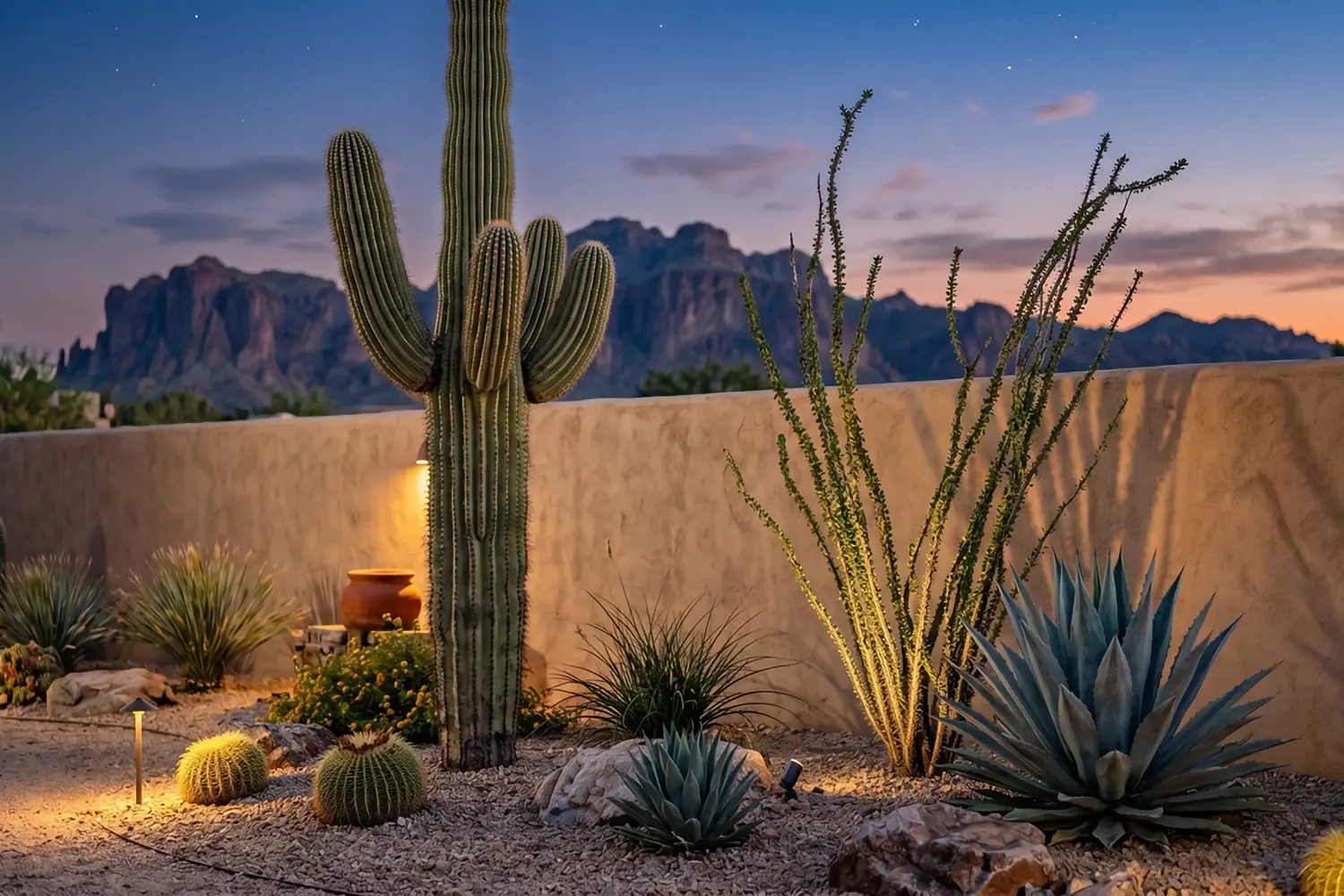
Saguaros. Here’s the thing about a saguaro — it’s tall and it’s got texture, those ribs running up the whole thing, and that’s the stuff you want to show off. So you uplight it. One fixture, sometimes two if it’s a big multi-arm specimen, placed a few feet back from the base and angled up. Not right at the trunk. Back a little, so the light rakes up the side and catches the ribs. That grazing angle is everything. You put the light straight on it dead center and it just flattens out, looks like a green pole. Pull it back, angle it, and suddenly you see the whole sculpture of the thing.
And go warm. Please. I see so many saguaros lit with this harsh blue-white light and it looks like a hospital. Warm white, like 2700K, maybe 3000K. The desert at night already has that warm tone to it and you want to lean into that, not fight it.
One more saguaro thing — don’t drown it. A saguaro lit with one good well-placed fixture looks incredible. The same saguaro with four fixtures blasting it from every side looks like a used car lot. Less is more out here. I mean that.
Ocotillos are tricky because for half the year they look dead. They’re not, that’s just what they do. But those whips, when you light them right, throw the coolest shadows. I usually go with a wider beam at the base and let it wash up through the canes. And the shadow play on a wall behind it, if you’ve got a wall, that’s where the magic is. The plant itself is kind of sparse so you’re almost lighting the shadow as much as the plant. When it blooms out red in spring it’s a whole different show, but even bare it earns its light.
Agave and other low stuff. Now here you flip the whole approach. Tall plants get uplit. Low sculptural plants like agave, you can uplight a big one, sure, but a lot of times I’d rather do a soft downlight, or what we call moonlighting. Put a fixture up in a nearby tree or on a structure and let it come down soft over the agave. It catches that rosette shape, the symmetry, and it casts this gentle shadow that mimics moonlight. Looks natural. Looks expensive. And it doesn’t blast some poor agave in the face all night.
Barrel cactus, golden barrels especially, those love a little grazing light to pop the ribs same as a saguaro, just smaller scale.
Palo verdes. Trees are their own conversation but real quick — a palo verde has that green bark and the airy canopy, and the move there is usually a combo. Uplight the trunk and main branches to show the structure, and if it’s big enough, get a downlight in the canopy for that dappled moonlight effect coming through the leaves. When they bloom yellow in spring, a palo verde lit well is one of the prettiest things you’ll see in a Phoenix front yard. I’m not exaggerating.
Here’s the bigger point under all of this. Desert plants got the way they are over a long time, all that adaptation to brutal sun and almost no water, and that’s exactly what makes them gorgeous at night when you light the form instead of just dumping light on them. The texture, the silhouette, the shadows. That’s the good stuff. A landscaper back in Ohio would kill for shapes like ours.
But you have to know what you’re looking at. Where to stand the fixture, what angle, how warm, how much. And that’s the part you can’t really fake from a box kit off Amazon. Those kits give you a pile of identical fixtures and no clue where to put them, and people end up lighting their whole yard like a parking lot and wondering why it looks off.
We’ve been doing this around Gilbert, Mesa, Chandler, Scottsdale, Queen Creek, all over the Valley for years now and the plants are honestly my favorite part. Hardscape and trim lighting are great but a well-lit saguaro stops people on the sidewalk.
If your desert landscaping is sitting there dark every night or it’s lit and it just doesn’t look right, that’s usually a quick fix once somebody who knows the plants takes a look.
Give us a shout at (480) 809-7800. Licensed and bonded, ROC# 340142. We’ll come walk the yard and figure out what each plant actually wants.