
We're in it right now, so the timing on this is good.
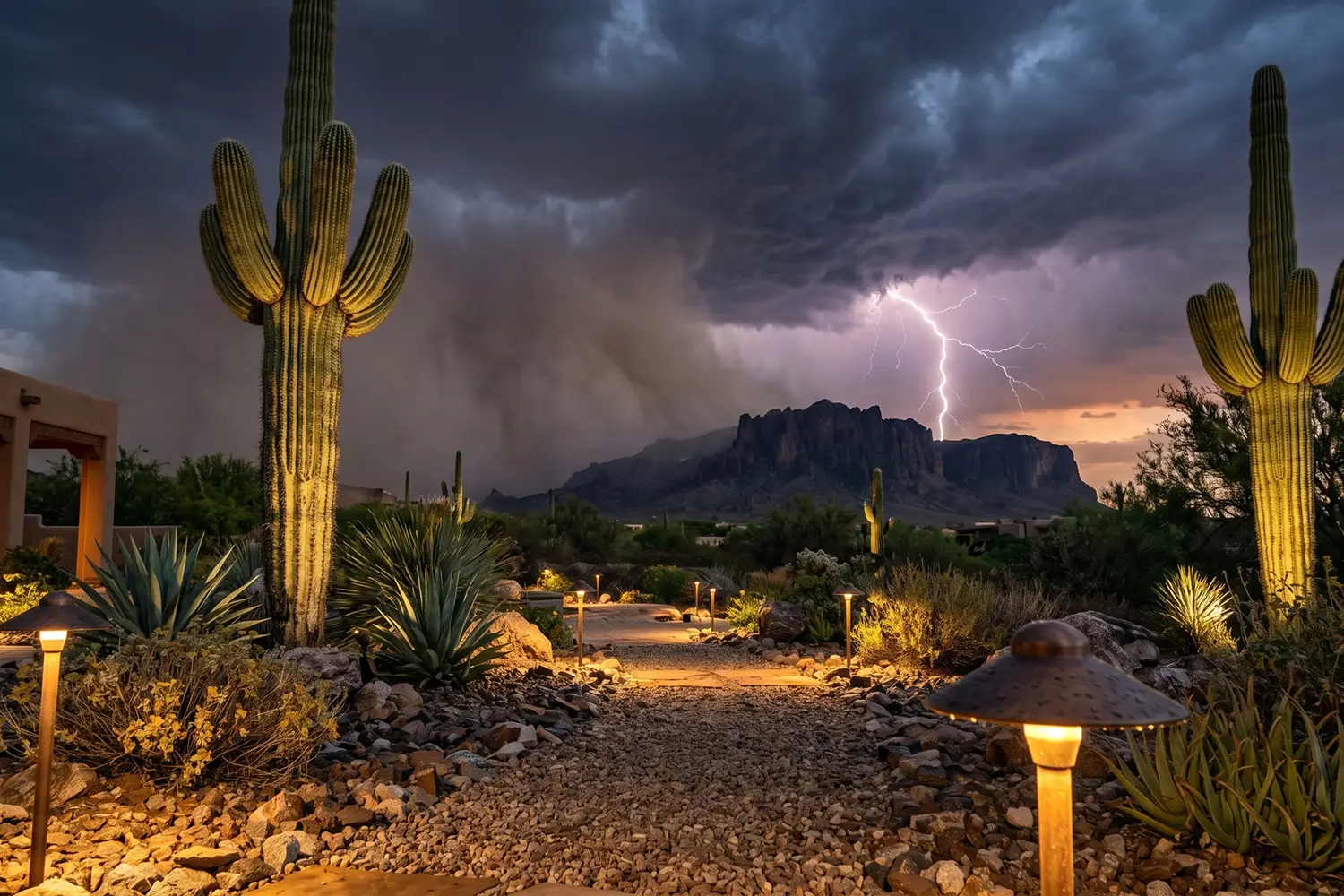
If you're new to Phoenix, monsoon season runs roughly from mid-June into September. And if you grew up somewhere with normal rain, the word "monsoon" probably makes you picture a gentle warm drizzle. No. Our monsoons are dust storms that turn the sky brown in the middle of the afternoon, then dead calm, then a wall of rain that dumps an inch in twenty minutes and floods streets that were bone dry an hour ago. Plus the humidity spikes, the temperature swings, lightning, wind that throws patio furniture into the pool. It's a lot. It's actually kind of incredible to watch if you're inside.
It is not great for outdoor lighting though. So let me run through what monsoon actually does to a system and what's worth doing about it.
Dust is the sneaky one. Everybody thinks about the rain and the wind. The dust is what gets your fixtures over time. A haboob — that's the big dust storm, the wall of brown — coats everything in a fine grit, and that grit settles on your lenses, packs into the little gaps, gets into connections that aren't sealed right. A fixture that was throwing a nice clean beam in May is now hazy and dim because the lens is filmed over with dust nobody wiped off. It's not broken. It's dirty. But it looks broken.
So part of monsoon prep is honestly just cleaning. Wipe the lenses. A damp cloth. Takes five minutes per fixture and it's the cheapest thing you can do to keep a system looking sharp.
Water finding its way in. Now, a properly installed low-voltage system is built for this. The fixtures are rated for it, the connections are supposed to be sealed, low-voltage is safe and it's designed to live outside getting rained on. That's the whole point.
But.
The weak spots are always the connections. And monsoon is when the weak ones show themselves. If a wire connection wasn't done right — somebody used a cheap twist cap instead of a proper waterproof connector, or a splice that was kind of half-sealed — the rain finds it. Water gets in, you get corrosion, and a few weeks later a section of your lights goes dark and nobody knows why. I get a wave of these calls every year right after the first big storms. Section out, "it was working fine," and I go out and find a connection full of water and green corrosion that was a ticking clock the whole time.
This is one of those areas where install quality you can't even see ends up mattering the most. Good waterproof connectors, gel-filled, sealed right, buried right — you never think about them because they just work, monsoon after monsoon. The bad ones you find out about in August.
Wind and flooding move stuff. Path lights and uplights sitting in the ground can shift during a big storm. Flash flooding washes out the soil around a fixture, wind catches a tree that's got a downlight in it. So after a real blow-through, walk the yard. Anything leaning, anything that got knocked cockeyed, anything where the beam's now pointed at the sky instead of the plant.
The timer and transformer. Your transformer should be mounted up off the ground and rated for outdoor use, and if it is, it's fine. But if you've got a setup where the transformer or the smart controller is sitting somewhere it could get hit by pooling water, that's worth a look before the heavy storms. Lightning's a thing too — a good surge situation matters more here than people think.
So here's the short version of getting ahead of monsoon.
Wipe your lenses. Walk the yard after big storms and straighten what moved. Watch for any section that goes dark, because that's almost always a connection that took on water and it'll only get worse. And if your system is more than a few years old or you inherited it from whoever lived there before and you have no idea how it was installed, get somebody to look at the connections before the season really cranks up, not after a section's already dead.
The honest truth is a well-installed low-voltage system handles our monsoons just fine. The sun does way more long-term damage to outdoor lighting out here than the rain ever will. But monsoon is when the corners somebody cut on the original install finally come due. If yours was done right, you'll mostly just be wiping dust off lenses. If it wasn't, you'll find out this summer.
We're out all over the Valley — Gilbert, Mesa, Chandler, Tempe, Scottsdale, Queen Creek, Phoenix — checking and repairing systems, and monsoon season is one of our busy stretches for a reason.