

This is one of those problems where people live with it for years and just assume that's how it is.
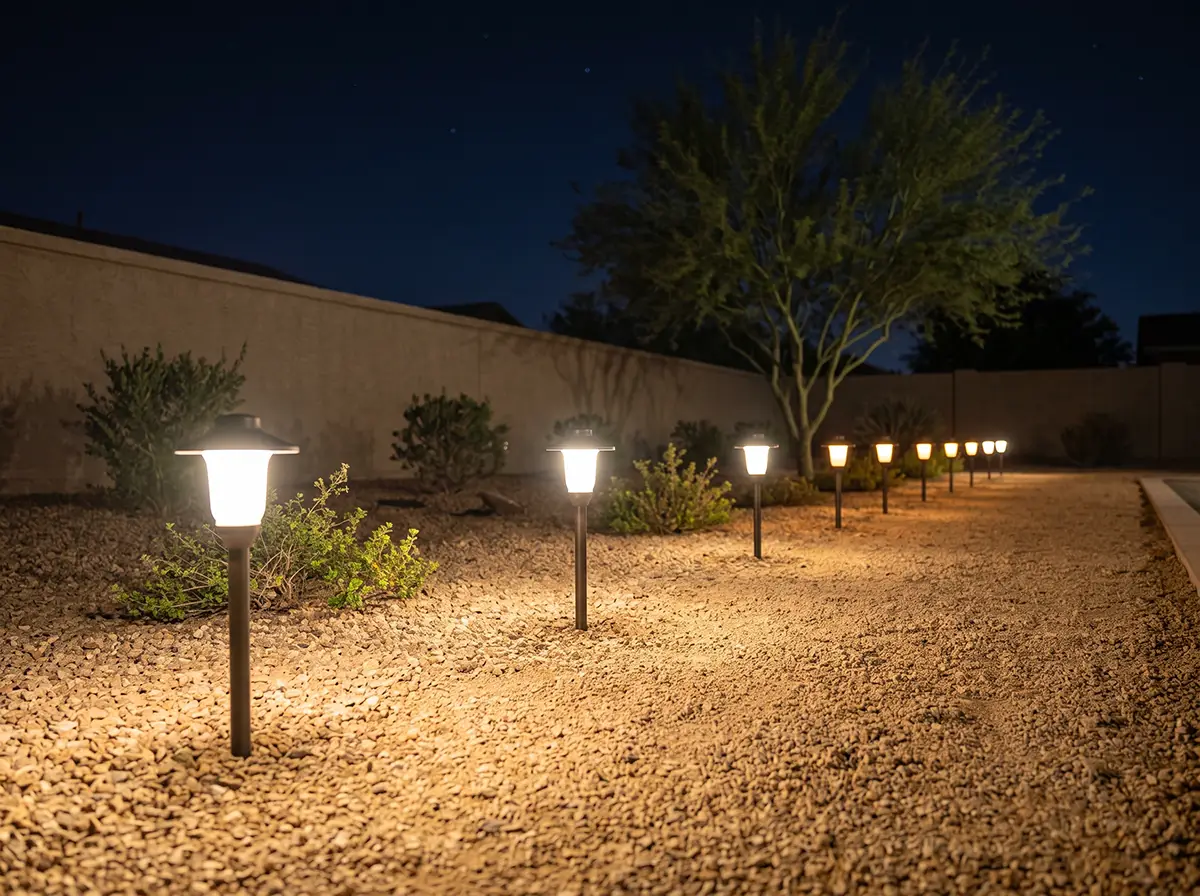
You walk out front, the first couple of fixtures near the transformer look great, and then as you go down the line they get progressively sadder. The last one out by the corner of the property is putting out this dim yellowish glow that doesn't match anything else. Maybe it flickers a little.
That's voltage drop. It's extremely common, it's a wiring problem and not a fixture problem, and about a third of the repair calls I go out on turn out to be some version of it.
The short version of what's happening
Low voltage lighting runs at 12 volts. The transformer takes your 120 from the house and knocks it down.
But electricity loses a little push as it travels through wire. The longer the run and the thinner the wire, the more it loses. So by the time you're 150 feet out from the transformer with a bunch of fixtures tapping off along the way, you might only have nine or ten volts arriving at that last light.
LEDs are more forgiving about this than the old halogens were — a halogen at ten volts goes noticeably orange and dim, whereas a lot of LED fixtures will hold their output down to a point and then fall off a cliff. But forgiving isn't the same as immune. Push it far enough and they dim, they shift color, they start flickering, and they die early. Running an LED driver below what it wants is hard on it.
So the fixture isn't broken. The fixture is starving.
Why it happens in the first place
Almost always it's one of a few things.
Wire that's too thin for the distance. This is the big one. Somebody used 16 gauge because that's what came in the kit, and 16 gauge is fine for twenty feet and hopeless at a hundred and fifty. For longer runs you want 12 gauge, sometimes 10. Costs more. Worth it. This is not a place to save forty dollars.
Everything daisy-chained on one long line. Fixture to fixture to fixture, all the way out. Every fixture on that chain is pulling from the same wire, so the ones at the end get whatever's left. There are better ways to lay out a run — you can loop it, you can split it into a couple of shorter runs, you can bring a heavier feeder out and branch from there. Any of those beat one long string.
Too much load on one transformer or one tap. People add fixtures over the years. Started with six, now there's fourteen on a transformer that was sized for the original six. Everything gets a little weaker and it happens slowly enough that nobody clocks it.
Bad connections. Those little pierce-style connectors that come with cheap kits are a real problem in Arizona. They corrode. Monsoon moisture gets in, the copper oxidizes, and now you've got resistance at that joint eating even more voltage. I pull a lot of green crusty connectors out of the ground.
How you can tell it's this and not something else
Easiest test — does the dimness follow the position or the fixture?
Swap the last fixture on the run with one from up near the transformer. If the dim one gets bright in its new spot and the bright one goes dim out at the end, it's not the fixtures. It's the wire.
Other tell: it's progressive. Not one dead light, but a gradual fade-off down the line. One light out is usually a bad bulb or a bad connection at that one spot. A gradient down the whole run is voltage.
If you've got a multimeter you can just measure it at the fixture. You want to be somewhere around 11 to 12 volts at the far end. Below about 10.5 and you're into the territory where things start misbehaving.
What fixing it actually looks like
Depends on how bad it is and how the yard is laid out.
Sometimes it's easy — a lot of transformers have multiple taps, a 12 volt and a 13 and a 14 and sometimes 15. Move the far run up to a higher tap and you've bought yourself a few volts. That's a five minute fix if you've got the headroom.
Sometimes we rebalance the loads, move some fixtures onto a different circuit so no single run is carrying everything.
Sometimes we split a long run into a couple of shorter ones, or reconfigure it as a loop so power's coming from both directions.
And sometimes the wire's just undersized for what's being asked of it and it needs to be pulled and replaced with something heavier. That's the least fun answer and it's the right one more often than people want to hear, especially on systems that were put in as a weekend project and then grown over time.
The reason I'm writing about this
Because I keep meeting people who think their landscape lighting "went bad" and are ready to replace the whole thing, and the fixtures are fine. It's a wiring layout problem from the original install. Fixing the wiring is almost always cheaper than replacing fourteen fixtures.
And on the flip side — if you're getting quotes for a new system, this is a decent thing to ask about. Ask what gauge wire they're running and how they're laying out the circuits. If the answer is vague or the number is 16 on a big yard, that tells you something.
Nobody's going to see your wire once it's buried. That's exactly why it's where corners get cut.
We repair and redesign landscape lighting systems all over the Valley — including the ones somebody else put in. Licensed and bonded, ROC# 340142. Give us a call at (480) 809-7800.