
I get asked this on probably half of my quotes and I've never written it down anywhere, so here it is.
Short answer: no, not really. It's a few dollars a month for most houses. Less than your Wi-Fi.
But people don't believe me when I say it that fast, and I understand why — you're looking at a couple hundred individual lights strung across your entire roofline and your brain says that has to cost something. So let's actually walk through it instead of me just telling you not to worry.
The actual numbers
A permanent trim system draws a fraction of a watt per diode. Call it around half a watt each, give or take depending on the system and the color and how bright you're running it.
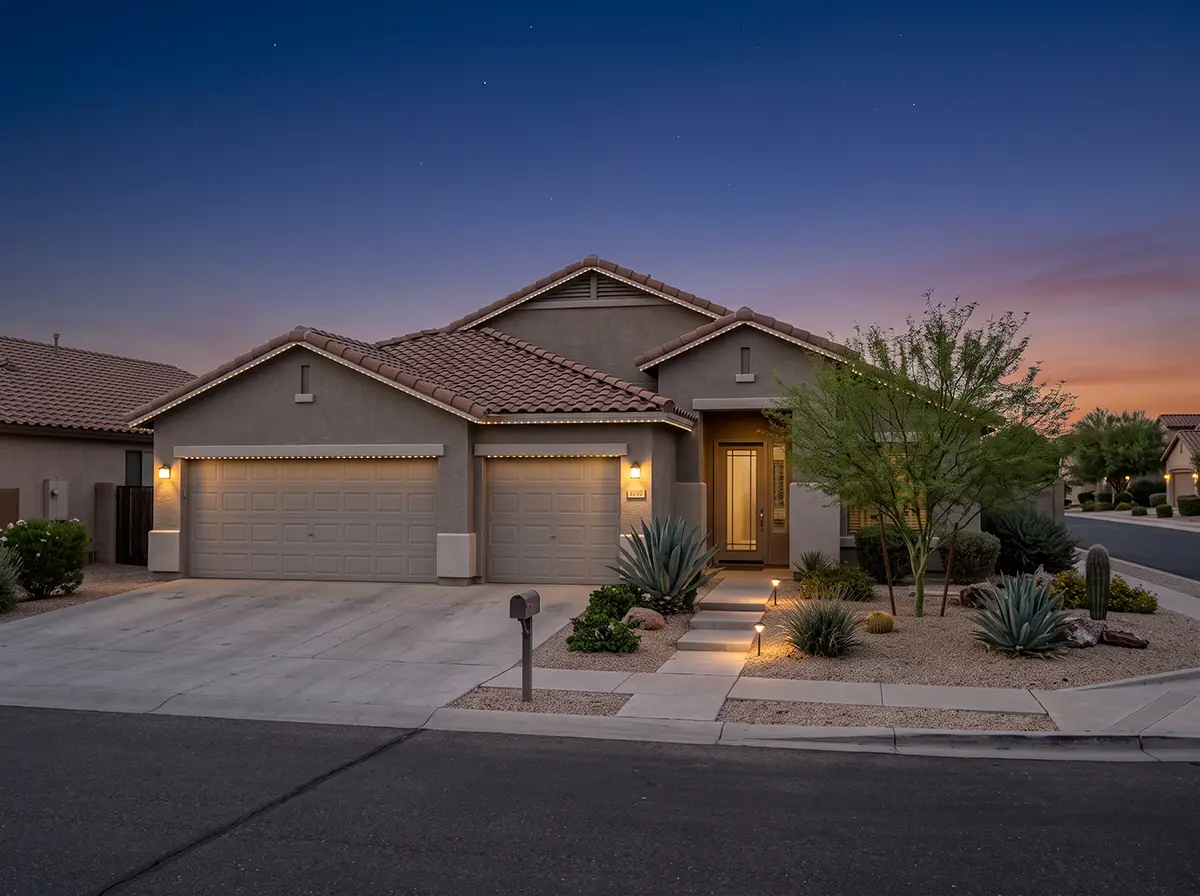
Typical single story house in Gilbert or Mesa, you're maybe looking at 150 to 200 lights on the roofline. Bigger two-story with a complicated roof, could be 300 or more.
So take 200 lights at half a watt. That's 100 watts. For the whole roofline. That is roughly one old-fashioned incandescent bulb — the kind that used to be in every lamp in the house.
Run that 100 watts for five hours a night, every night. That's half a kilowatt-hour a day. Over a month, about 15 kilowatt-hours.
APS and SRP residential rates move around with plan and season, and I'm not going to pretend to quote you a rate because it depends on your plan and what time of day you're running things. But at a typical residential rate you're landing somewhere in the neighborhood of two to four dollars a month.
That's the whole thing. Two to four bucks.
Why it's so low
Two reasons and they're both about LEDs.
The first is just that LEDs are absurdly efficient compared to what people are used to comparing them against. If you grew up with C9 incandescent Christmas bulbs, those things pull five to seven watts each. A hundred of them is 500 to 700 watts, which is a real load — that's why the lights used to dim a little when you plugged in the Christmas display, and why people blew fuses every December. A hundred LED diodes is fifty watts. Same visual job, roughly a tenth of the draw.
The second is that you're almost never running at full output. Full brightness, all colors firing, is the maximum draw, and nobody actually lives that way. Everyday warm white at a comfortable level is a lot less. Most of my customers end up running theirs dimmer than they expected to, because it looks better that way.
Where it goes up
Full color displays can pull more than warm white. If you're running red and green and blue all through December at max brightness, that month costs more than August. Still not a big number, but it's real.
Animations and effects will take more power too. The chasing patterns, the twinkle, the stuff that's fun for a few nights around the holidays.
And obviously, more roofline is more lights. A big custom home with a lot of gables and dormers might be double what a Sun City ranch house is.
But even doubling the number I gave you, you're talking about the cost of a sandwich per month.
The comparison people should actually be making
Nobody asks me what their old setup cost, and that's the more interesting question.
If you were paying somebody to hang Christmas lights and take them down every year — that's not a small number in this market, and it's every single year forever. If you were doing it yourself, it's a Saturday plus whatever your Saturday is worth plus the strands you replace because half of them didn't work when you pulled them out of the box.
Against that, a few dollars a month of electricity is noise. The install cost is the real number to think about and the running cost basically isn't a factor in the decision. Which is what I tell people when it comes up on a quote, and then they usually don't believe me, and then a couple months later I hear from them that they couldn't find it on the bill.
That's the most common feedback I get on this, actually. Not "it was cheap." It's "I went looking for it on my APS bill and I couldn't tell which part was the lights."
One thing that does matter
Get a system with a decent power supply and don't run it right at the edge of what it's rated for. This isn't really about your monthly bill, it's about the equipment lasting.
Cheap drivers run hot, and running hot in an Arizona attic space or against a west-facing fascia in July is how they fail early. A properly spec'd system with some headroom runs cooler and lasts longer. That's not a cost-of-electricity thing, that's a don't-replace-this-in-four-years thing.
Same reason I don't install the bargain systems. It's not that they use more power. It's that they don't survive out here.
Thinking about permanent trim lighting for your Valley home? We'll come out after dark, walk your roofline, and give you an itemized quote — free, no pressure. Licensed and bonded, ROC# 340142. Call (480) 809-7800.