
Alright let's just get into the money because I know that's what's stopping most people from picking up the phone. You see the price for a professional Gemstone Lights install and yeah, there's a little sticker shock. I'm not gonna pretend there isn't. But here's what I need you to do — go look at what you're actually spending right now.
If you're hiring a crew to hang Christmas lights every year, you're probably paying somewhere around $400 to $500 to put them up. Then another $200 or so to take them down. That's $700 a year and you own nothing. You're renting light. Do that for five years and you've burned through $3,500 and all you've got is a tangled mess of green wire shoved in a plastic bin in the garage. Maybe some of it still works. Probably not.
A permanent system is a one-time hit and then you're done with it. Most people I talk to break even somewhere around year four or five versus what they were dumping into seasonal installs. But the part that gets overlooked — and this is what I always end up telling people — you're not just getting Christmas lights here. You're getting the whole year. Fourth of July, your kid's birthday party, random Tuesday night hanging out by the fire pit in February with a warm white glow going. You paid for all 365 days, not just that little window from mid-November through New Year's.
The electric bill thing comes up a lot too so let me just knock that out. Each Gemstone bulb pulls about one watt at full brightness. One watt. Your old C9 incandescent strands were pulling like seven watts per bulb. So you could run Gemstone Lights literally all night every night and your power bill would barely move. Most of my customers in Mesa and Gilbert tell me they can't even find the difference on their statement.
Now here's what nobody thinks about until I bring it up. The replacement tax. Every single November you're back at Home Depot buying new strands because the Arizona sun cooked last year's set into brittle garbage. The plastic gets foggy, the wires get stiff, half the strand doesn't work and you can't figure out which bulb killed it. That's another $150, $200 a year just thrown away. Gemstone tracks are aircraft-grade aluminum with UV-stabilized polymers. These things are built to sit on your roof for 20-plus years in full desert sun. You're not replacing anything. That alone changes the math pretty drastically when you zoom out.
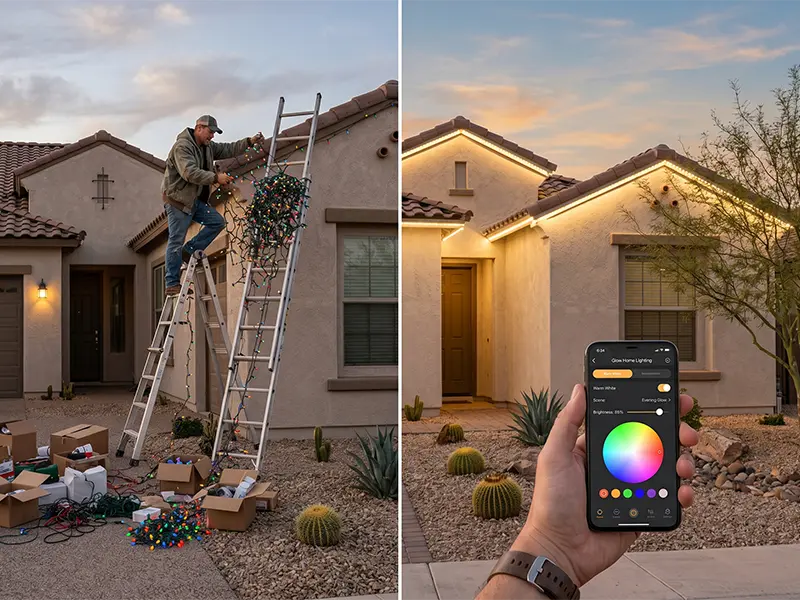
And your time — what's that worth to you? Seriously. How many weekend hours have you spent untangling lights on the garage floor, testing bulbs one by one, climbing up on a ladder trying not to fall off a two-story roof? I've talked to guys who spend an entire Saturday just getting lights up. Then another half day taking them down in January when it's finally cool enough to deal with it. With Gemstone you open the app on November 1st, tap your Christmas preset, and you're done. Sitting on the couch. Watching the game. Whatever you want. That Saturday is yours again.
Something I think is worth mentioning for anyone who might sell their house in the next few years — this stuff adds real value. Professional architectural lighting is a permanent improvement. When a buyer walks up to your house in Gilbert or Chandler and sees a clean, integrated lighting system already installed? That's a selling point. It fits right into the whole smart home thing that everyone wants now. You're not just spending money on lights, you're putting equity into the exterior of your property.
One more thing because I see people try to cut corners on this and it always backfires. Those cheap LED strips you find on Amazon or some random website — they don't have a dedicated warm white diode. They're mixing RGB to fake a white and it comes out looking blue and weird. They also have zero surge protection. One lightning strike anywhere near your house and the whole system is fried. Every single Gemstone bulb has its own individual surge protector built in. So worst case, a close strike pops one bulb instead of killing a $2,000 system. That kind of engineering is why the price is what it is. But when you're not replacing the whole thing after one monsoon season, the cost of ownership isn't even close.
Oh and the hub — I almost forgot about this. You're not just getting bulbs and a track. There's a cloud-connected controller that gets over-the-air updates. So the system actually improves after you buy it. New features, new light patterns, better app functionality. The cheap stuff is outdated the day you open the box. This is more like buying into a platform. When you add it all up — the durability, the energy savings, getting your weekends back, the home value, the fact that it keeps getting better — the permanent route honestly just makes more financial sense for anyone living out here in the Valley. It's not a splurge. It's the math finally making sense.