

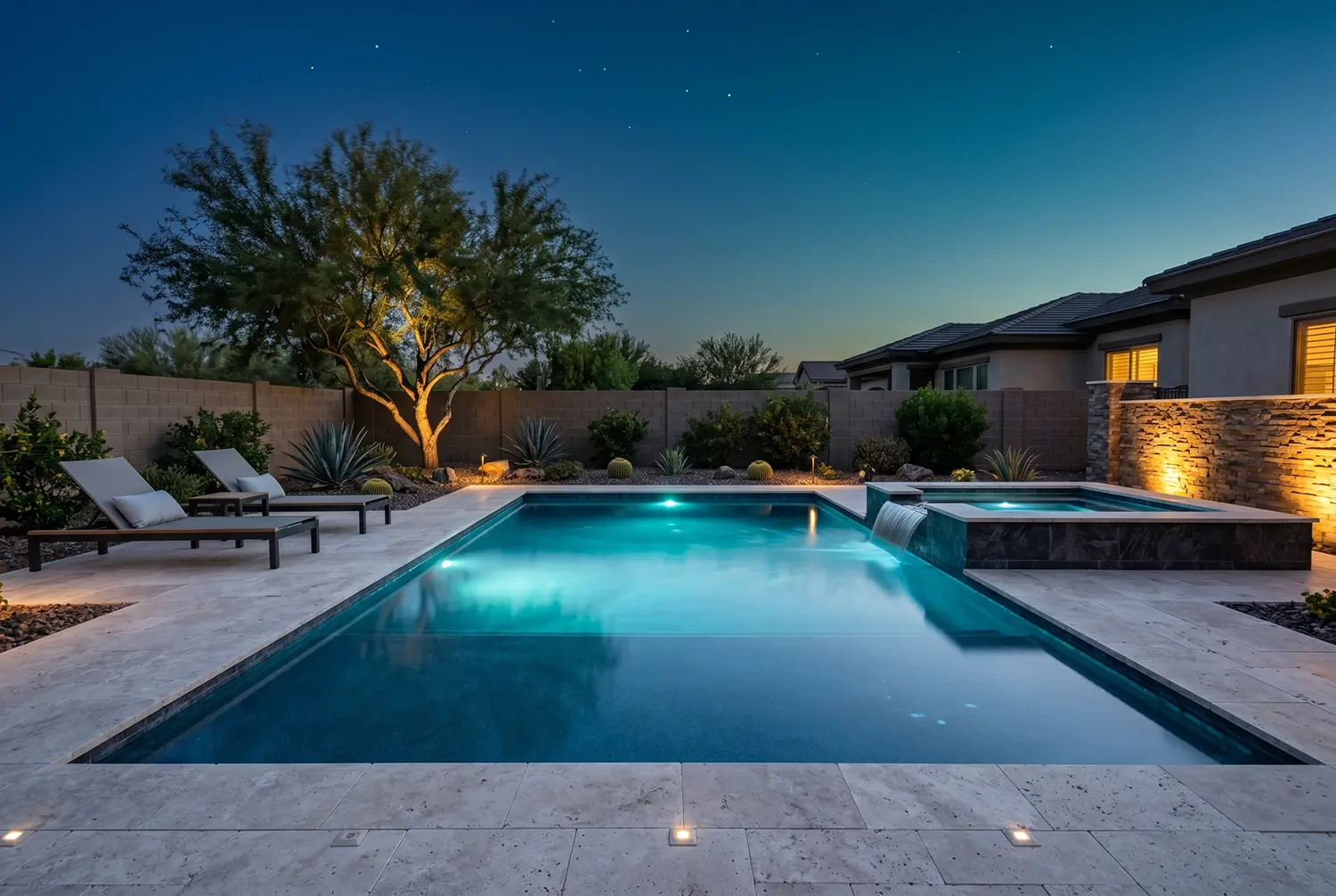
Almost every home I work on in the East Valley has a pool. That's just how it is out here. Gilbert, Mesa, Chandler, Queen Creek, it feels like 80 percent of the houses were built with a pool in the backyard. Which makes sense because what else are you going to do when it's 115 degrees for three months straight.
But the lighting situation on most of these pools is basically whatever the builder stuck in there ten years ago. One white light in the wall of the deep end. Maybe two if it's a bigger pool. That's what the builder included and that's what people have been living with ever since. It works. You can see the water at night. But it's like saying a bare lightbulb in the ceiling "works" for your living room. Technically true. Missing the point entirely.
Pool lighting has come a long way and if you haven't looked at the options recently you might be surprised at what's out there now.
The In-Pool Light Upgrade
That single white incandescent light your builder installed? First off it's probably burning a ton of electricity compared to what's available now. Second, if it's original to the house it's probably dimmer than it used to be and might be on borrowed time anyway. Those old incandescent pool lights run hot and the sealed housings eventually fail. When they do you're looking at draining the pool or hiring a diver to swap it out. Neither is cheap.
Modern LED pool lights fit into the same niche as the old ones in most cases. You don't need to jackhammer your pool shell to upgrade. The LED replacement draws a fraction of the power, lasts way longer, and here's the fun part, most of them do color. Full RGB color changing from an app or a wall switch depending on the system.
Now I know color changing pool lights sound kind of gimmicky. And they can be if you're running through rainbow cycles every night like a nightclub. But being able to set your pool to a deep blue or a soft turquoise or a warm white depending on the occasion is actually really nice. Halloween you throw it on orange. Fourth of July goes red white and blue. Normal Tuesday night? Warm white. It's one of those things where once you have the option you end up using it more than you expected.
What's Around the Pool Matters More Than What's In It
This is the thing I try to explain to every pool owner I talk to. The light inside the pool is maybe 30 percent of how your pool area looks at night. The other 70 percent is everything around it. The deck, the water feature wall, the landscaping behind the fence line, the raised bond beam, all of that.
Put a couple of warm wash lights on the wall or fence behind the pool and suddenly the water is picking up reflections. The surface turns into this mirror that bounces warm light around and the whole area feels ten times more inviting. It's the same pool. Same water. Completely different experience at night just because you changed what the water is reflecting.
If you've got a raised spa or a spillover feature that's another opportunity. A light behind the spillover so you can see the water sheeting over the edge? That looks incredible. The moving water catches the light differently every second and it creates this shimmer effect that honestly I never get tired of seeing. Some of my favorite installs have been really simple, just two or three fixtures around a pool and spa combo that completely transform the space.
Deck Lighting for Safety and Looks
Here's where the practical side comes in. Wet pool decking at night is a slip hazard. Period. Especially cool deck or textured concrete that gets slick when it's wet. You need enough light for people to see where they're walking, where the pool edge is, and where the steps are.
But you don't want to overdo it. A bunch of bright fixtures aimed at the deck creates glare on the water surface which kills the whole vibe you're trying to create. And it's actually worse for visibility because the glare makes it harder to see the pool edge, not easier.
Low level deck lights are the way to go. Small fixtures mounted in or near the deck surface, maybe in the raised wall of a planter or the face of a step. They throw light down at foot level where you actually need it without putting any glare on the water. You can see where you're stepping but the pool surface stays dark and reflective which is what makes it look good.
If you have steps going into the pool, lighting those is not optional in my opinion. That's a liability thing. It's dark, people have been drinking, the steps are wet. You need to be able to see them clearly. A small LED strip under the coping or a fixture aimed at the step area handles this without ruining the aesthetic.
Fiber Optic and Perimeter Effects
Fiber optic pool lighting used to be more popular than it is now. The idea is you have a light source away from the pool and fiber optic cables carry the light to various points around the pool perimeter or inside the pool itself. The advantage is no electrical components in the water which some people like from a safety perspective.
The downside is maintenance. Those fiber optic cables get brittle over time especially in our heat. The light output fades as the cables age. And the illuminator box that powers them needs to be accessible for lamp changes. I've ripped out more fiber optic systems than I've installed at this point because homeowners got tired of dealing with dim uneven lighting and cables that kept breaking.
For perimeter effects, small individual LED fixtures at this point are better. More reliable, easier to replace if one fails, and better light output. A strip of warm LEDs under the coping around the pool edge creates this floating glow effect that outlines the whole pool shape at night. Looks amazing and it's basically maintenance free for years.
The Color Temperature Debate
For pool area lighting specifically, I almost always recommend sticking in the 2700K to 3000K range for everything outside the pool. Warm. Amber. Inviting. It matches the way the desert looks at night and it makes skin tones look natural which matters when you're out there in a swimsuit. Nobody looks good under cool white light. I'm sorry but it's true.
Inside the pool you've got more flexibility since the water itself changes the color perception. A slightly cooler white at maybe 4000K can make the water look really crisp and clean and Caribbean blue. Or stick with warm white for a more natural lagoon look. Depends on your pool finish honestly. A pebble tech finish in a darker color responds differently than a light plaster finish.
Play with it. That's the nice thing about LED color systems. You can try different looks and settle on what you like without swapping any hardware.
My Usual Recommendation for Most Homes
For a typical East Valley home with a standard pool and spa combo, I usually suggest starting with an LED upgrade for the in pool light, two to three wash lights on the back wall or fence, low level lighting on any steps or elevation changes around the deck, and maybe one accent light on a feature plant or water element near the pool.
That's usually six to eight fixtures total around the pool area and it makes an enormous difference versus that one lonely builder light in the deep end. The cost is reasonable and the result is a pool area you actually want to spend time at after dark instead of just swimming in the dark and hoping you don't kick your kid in the head because you can't see them.
Reach out if you want to talk through what would work for your pool setup. I've probably seen a version of your exact backyard layout about 200 times by now so I can usually tell you pretty quickly what's going to make the biggest difference.