
People ask me a lot of good questions before they sign off on a lighting project. What fixtures, what it costs, how long the LEDs last. But the question I get least often is the one I'd probably ask first if I were the customer, which is: what is this actually going to be like at my house?
I think people don't ask because they assume it's obvious, or maybe they don't want to seem like they're worried about it. So here's the whole thing, start to finish, no mystery.
Before anybody shows up
The design walk already happened by this point, usually a few weeks earlier and almost always after dark, which is when we worked out what's getting lit and roughly where all of it goes. So by the time install day rolls around the plan is settled and nobody is standing in your driveway improvising.
There isn't much we need from you ahead of time. Mostly it's knowing where your outdoor outlets are and having a way into the side gate, plus a heads up if you've got dogs so that isn't something we find out at eight in the morning when somebody swings a gate open.
Morning: layout
The first thing that happens is we walk the property and physically set the fixtures on the ground where they're going, without connecting anything. It looks a little strange, like somebody scattered lights around your yard and left.
There's a reason for it though. A plan on paper is a plan on paper, and until you see the actual spacing against the actual plants, you don't really know. Every so often we get everything laid out and realize a fixture we intended for one agave is going to end up blasting straight into the neighbor's kitchen window, so we move it. Better to catch that now than after it's wired and buried.
If you're home, this is the best moment to walk it with us. Fixture positions are still completely free to change at this stage. Two hours later they're not, or at least not without redoing work.
Midday: wire and trenching
This is the long, boring, unglamorous part, and it's also the part that determines whether your system still works in ten years.
We run low-voltage wire from the transformer out to each fixture, tucked into shallow trenches, under the gravel, behind the block, along the base of the wall. In a desert yard this is mostly working through decomposed granite and caliche, and caliche is miserable stuff to dig, so this is where most of the day goes.
The connections are the part I'd tell you to care about, because every splice in a run is somewhere the system can eventually fail, and the ground out here heats and cools hard enough that things work themselves loose over the years. Then monsoon moisture finds the loose spot. So every junction we make gets a proper waterproof connector, which costs more and takes longer than twisting on a wire nut and wrapping the whole thing in electrical tape. I get called out to repair the electrical tape version fairly often, usually around three summers after somebody else put it in.
The transformer goes up near the outlet, and we deliberately size it larger than the job actually calls for so there's capacity sitting there for whatever you decide to add on later, which in my experience is just about everybody eventually.
Afternoon: mounting and burial
Fixtures get set while wires gets buried and everything gets cleaned up. By late afternoon your yard should look basically the way it did when we got there, except with fixtures in it.
For a typical residential landscape job we're usually talking one day. Bigger properties or anything with a lot of hardscape to work around can run two. Permanent trim on the roofline is its own animal and can be a day or two depending on how much roofline there is and how complicated the architecture gets.
After dark: the part that actually matters
Here's the thing almost nobody knows going in, and it's the part I care most about.
We come back at night. Not to check that the lights turn on, but to aim them. You cannot aim landscape lighting in daylight. It's not that it's harder, it's that it's genuinely impossible, because you cannot see what the light is doing until it's the only light there is.
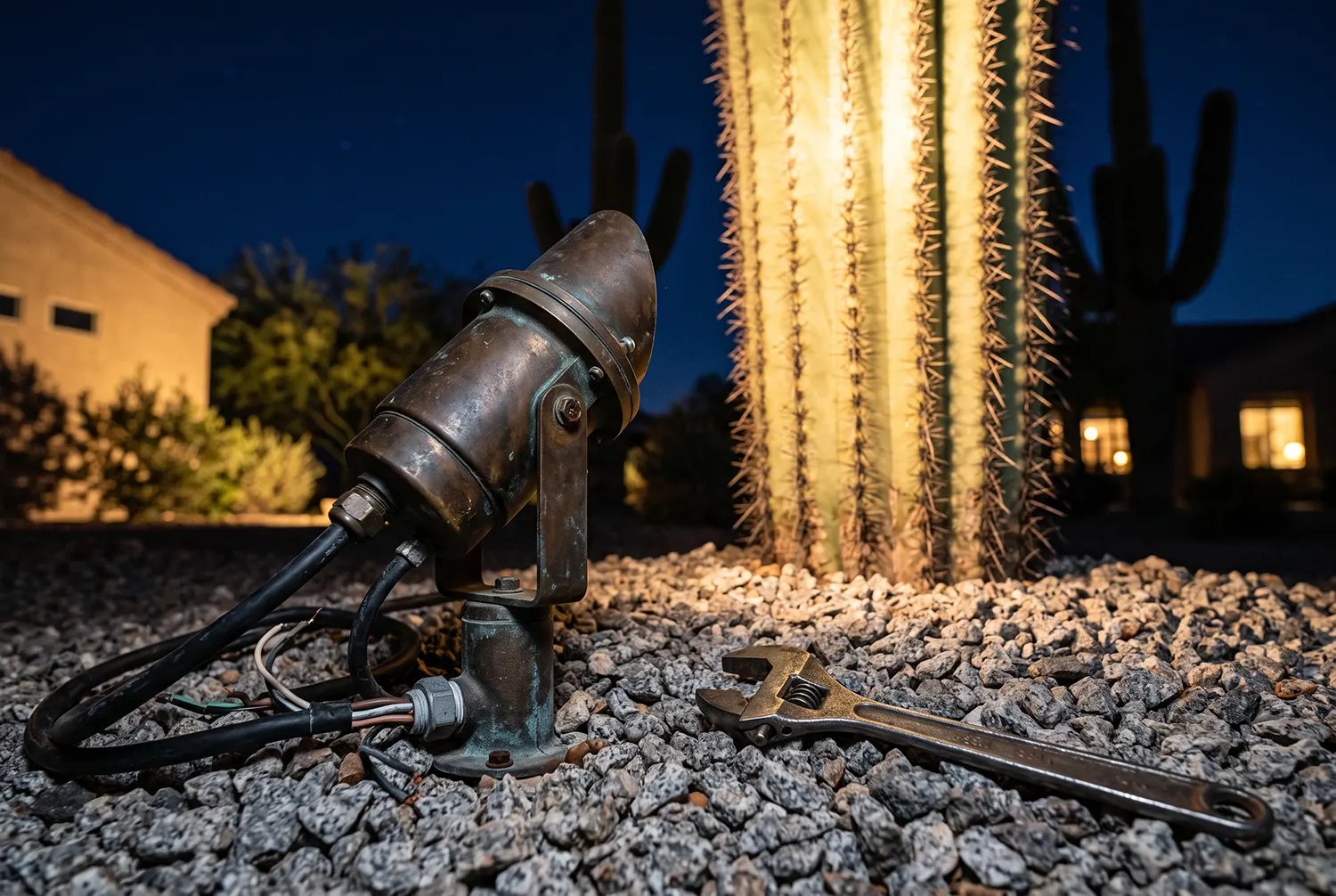
So we're out there in the dark with a wrench, moving things a few degrees at a time. Maybe a fixture gets tilted down so it grazes up the ribs of a saguaro instead of washing it out flat, or one gets rotated off a window it was catching, or an uplight gets pulled back from a wall so the beam has some room to soften before it lands. It's fussy and it takes a while. It's also the step a lot of cheaper outfits skip entirely, since it means sending somebody back out a second time for work that never shows up as a line on the invoice.
If you're home for that part, come out. It's the fun bit. You'll see things get better in real time, and if there's something you don't love, right then is the easiest possible moment to change it.
Then we're done
We set the timer or the app schedule, show you how to run it, and go. You get a system that turns itself on at dusk and does its thing without you thinking about it.
The main thing I want people to take from this is that install day is not disruptive. There's no power shut off, no crew inside your house, no reason you can't work from home through the whole thing. Most of my customers spend the day doing entirely normal stuff and then walk outside that night to a house that looks different.
— Sam
Desert Outdoor Lighting has served the Phoenix Valley since 2004. Licensed and bonded, ROC# 340142. Get in touch for a free after-dark design visit and we'll walk your property together.